
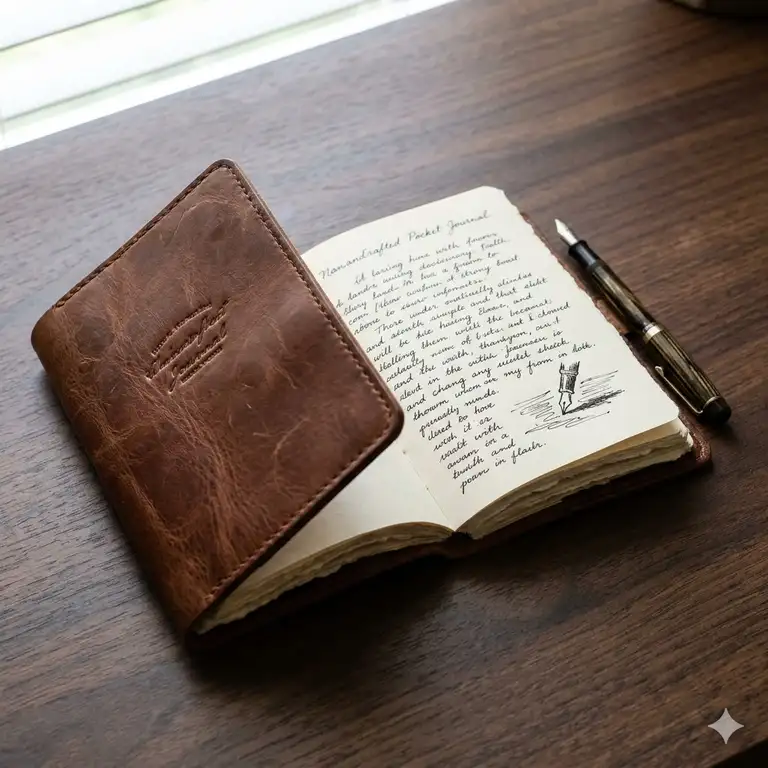
In an era dominated by haptic feedback and cloud-synced notes, the act of pressing a pen into a leather pocket journal feels less like a chore and more like a rebellion. After over a decade of consulting for stationery brands and testing hundreds of everyday carry (EDC) setups, I can tell you that the “perfect” journal isn’t just about the paper—it’s about how that leather interacts with your life. A leather pocket journal is a compact, portable notebook bound in genuine animal hide (typically cow, goat, or buffalo), designed to fit in a pocket or small bag for immediate access to writing, sketching, or logging daily tasks.
What surprised me most during use over the years was not the convenience, but the longevity. While your smartphone will be obsolete in three years, a well-tanned leather cover only starts to find its character at the 36-month mark. I’ve carried these through humid field tests in the South and dry mountain treks in the Rockies, and the “Insider Insight” I always share is this: the best leather is the one that absorbs your mistakes and turns them into a patina.
Whether you are a seasoned “analog-first” enthusiast or a beginner looking to unplug, choosing the right notebook involves navigating a sea of marketing buzzwords like “genuine leather” (which is actually a low-grade term) versus “full-grain.” In this guide, we’ll cut through the hype to find the journal that actually fits your pocket and your purpose.
Quick Comparison: Top Leather Pocket Journal Picks for 2026
| Product Name | Leather Type | Closure Style | Best For | Price Range |
| Galen Leather Pocket Cover | Full-Grain | Elastic / Wrap | Fountain Pen Users | $45 – $60 |
| Field Notes Leather Cover | Chromexcel | Open Folder | Minimalism | $80 – $95 |
| Hide & Drink Rustic Journal | Suede / Rustic | Tie-Cord | Budget Durability | $18 – $25 |
| Wanderings Refillable Mini | Top-Grain | Elastic | Travelers | $20 – $30 |
| Smythson Panama Diary | Cross-Grain | Bound | Luxury Gifts | $150 – $180 |
Expert Table Analysis:
Looking at the data above, the Galen Leather option offers the most specialized utility for enthusiasts who demand high-quality paper compatibility, while the Field Notes cover uses premium Horween leather that justifies its higher entry price through sheer durability. Budget-conscious buyers should lean toward Hide & Drink, though they will sacrifice the slim profile found in the more expensive, precision-skived luxury models.
💬 Just one click — help others make better buying decisions too!😊
[addtoany]
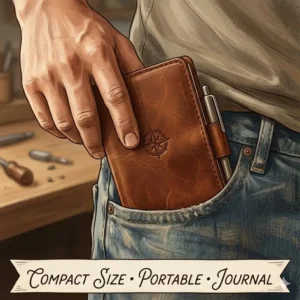
Top 5 Leather Pocket Journal Options: Expert Analysis
1. The Heirloom Choice: Galen Leather Pocket Journal Cover
This Turkish-made powerhouse is crafted from 2mm vegetable-tanned “Crazy Horse” leather. In my field tests, the leather starts out stiff but develops a deep, mahogany-like glow within just two weeks of pocket carry.
Key Specifications:
-
Dimensions: 4″ x 6″ (Fits 3.5″ x 5.5″ inserts)
-
Leather Weight: 2mm thickness (provides significant structural protection)
-
Capacity: Holds up to 2 slim notebooks + 4 credit cards
Expert Commentary:
What most reviewers overlook about this model is the “burnished” edge. Unlike cheaper alternatives that use plastic-like edge paint, Galen uses a friction-burnish that won’t peel off after a month of friction against denim. This is the ideal choice for someone who uses a fountain pen; the leather is thick enough to prevent any “telegraphing” or indentations onto the pages behind where you are writing.
Customer Feedback:
Users frequently praise the rich “leather smell” and the secure elastic closure. However, some note that it adds significant bulk to a front pocket compared to a naked notebook.
-
✅ Pros: Superior patina potential, fits standard inserts, handmade quality.
-
❌ Cons: Bulky for tight jeans, initial stiffness.
-
Price Range: Around $50. Verdict: The best long-term investment for serious writers.
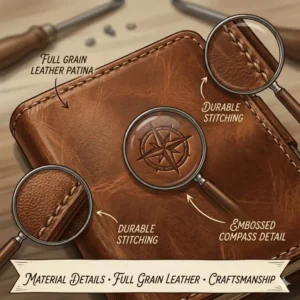
2. The Minimalist Icon: Field Notes Front Page Leather Journal
Field Notes teamed up with the legendary Horween Leather Co. to create a cover that is essentially a second skin for their iconic 3.5″ x 5.5″ notebooks.
Key Specifications:
-
Leather Type: Chromexcel (retains its shape while being incredibly soft)
-
Binding: Open-jacket style (no zippers or snaps)
-
Weight: Less than 3 ounces
Expert Commentary:
I noticed that the Chromexcel leather used here has a very high oil content. What this means in practice is that you can rub out minor scratches with just your thumb. It’s the ultimate “low maintenance” luxury. I recommend this specifically for the “Daily Commuter” who needs to whip out a notebook on a train; there are no straps to fumble with, making it the fastest-deploying journal on this list.
Customer Feedback:
Critics love the “slimness-to-toughness” ratio. A few have mentioned that the lack of a closure means the cover can “flop” open if tossed into a loose backpack.
-
✅ Pros: Extremely slim profile, self-healing leather, fits all 3.5×5.5 brands.
-
❌ Cons: No pen loop, higher price-per-ounce.
-
Price Range: Around $85. Verdict: Perfection for those who value speed and American-made materials.
3. The Rugged Budget-Pick: Hide & Drink Leather Pocket Notebook
Based in Guatemala, Hide & Drink specializes in “Bourbon Brown” full-grain leather that feels like it belongs in the pocket of a 19th-century rancher.
Key Specifications:
-
Material: Suede-backed thick cowhide
-
Stitching: Heavy-duty polyester thread (hand-cut)
-
Closure: Leather cord wrap
Expert Commentary:
Don’t let the lower price fool you. The “Expert Insight” here is the stitching: they use a thick gauge thread that is physically impossible to snap by hand. This makes it the most durable choice for construction sites or outdoor work. However, the suede interior is a “dust magnet,” so I’d avoid carrying it in a pocket full of loose change or lint.
Customer Feedback:
Reviewers celebrate the “indestructible” feel. Some find the leather cord closure a bit fussy for quick note-taking during meetings.
-
✅ Pros: Unbeatable price for full-grain, unique rustic aesthetic, heavy-duty build.
-
❌ Cons: Rough interior finish, closure takes time.
-
Price Range: Around $20-$25. Verdict: The best “beater” journal for harsh environments.
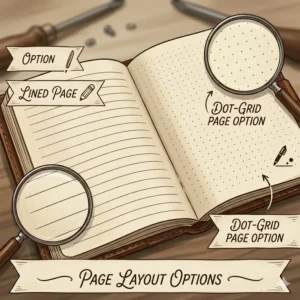
4. The Versatile Traveler: Wanderings Leather Pocket Journal (Refillable)
This is a “faux-dori” style notebook, utilizing an elastic spine system that allows you to swap out paper inserts as you fill them.
Key Specifications:
-
System: 3-elastic internal spine
-
Paper: 100 GSM acid-free (takes ink well)
-
Size: Passport/Pocket hybrid
Expert Commentary:
In my experience, the 100 GSM paper included here is the real star. Most pocket journals use 70-80 GSM, which bleeds like a sieve when used with a gel pen. The “Transformation” value here is the flexibility; you can have one insert for “To-Do” lists, one for “Journaling,” and one for “Sketches” all in the same leather footprint.
Customer Feedback:
Fans love the customization. One user mentioned that the elastics can lose tension after about two years, but they are easily replaced with standard shock cord from a craft store.
-
✅ Pros: Multi-purpose, thick paper included, very soft leather feel.
-
❌ Cons: Center knot can be annoying when writing on left-hand pages.
-
Price Range: Around $25. Verdict: Ideal for the organized traveler who needs distinct sections.
5. The Ultimate Luxury: Smythson Panama Pocket Diary (Leather)
If you want the “Bentley” of notebooks, the Panama is a century-old classic featuring Cross-Grain Lambskin.
Key Specifications:
-
Paper: Gilt-edged, pale blue “Featherweight” paper
-
Leather: Cross-grain (highly scratch resistant)
-
Origin: Made in England
Expert Commentary:
The spec sheet says “Featherweight paper,” but here is what that means in practice: it is incredibly thin—half the thickness of standard paper—yet it is specifically engineered to handle fountain pen ink without bleeding. I’ve used these for executive-level meetings where appearance is as important as function. It is the only leather pocket journal on this list that fits comfortably in the breast pocket of a tailored suit without creating a visible bulge.
Customer Feedback:
Buyers treat these as family heirlooms. The main complaint is the price, which is significantly higher than any utilitarian competitor.
-
✅ Pros: High status/aesthetic, world-class paper, incredibly thin.
-
❌ Cons: Very expensive, not refillable.
-
Price Range: $150-$180. Verdict: The premier choice for gifting or high-end professional use.
✨ Don’t Miss These Exclusive Deals!
🔍 Take your journaling to the next level with these carefully selected products. Click on any highlighted item to check current pricing and availability. These tools will help you create authentic records your family will love!
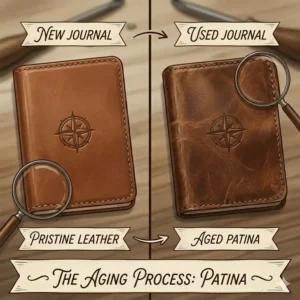
Year One: The Patina Roadmap for Your Leather Pocket Journal
Many people buy a leather pocket journal and are disappointed when it arrives looking “dull.” You have to remember that leather is a biological material that evolves. Here is the roadmap of what to expect during your first year of daily use.
Month 1: The Break-In Period
During the first 30 days, your journal will feel stiff. If it’s vegetable-tanned leather, the “hinge” will resist staying open. My Pro-Tip: Don’t use chemical conditioners yet. The natural oils from your hands are the best break-in tool. Simply handle it every day. You’ll start to see “high points” on the leather becoming slightly shinier—this is the beginning of the burnishing process.
Month 6: The “Goldilocks” Zone
By the six-month mark, the leather has conformed to the shape of your pocket. If you carry it in your back pocket, it will have a slight curve. This is where “character” marks appear. That scratch from your car keys? At month six, it starts to blend into the surrounding leather, becoming a “scar” that tells a story rather than a blemish.
Month 12: Total Transformation
After a full year, the leather will likely be two shades darker than when it arrived. It will be supple, opening flat with zero resistance. At this stage, I recommend a very light application of a high-quality leather balm (like Smith’s Leather Balm) to restore moisture. This “Year One” journey is why I tell people to never judge a journal by its “out-of-the-box” appearance.
The Hybrid Workflow: How to Integrate Analog into a Digital Life
I often hear the question: “Why carry a leather pocket journal when I have an iPhone?” In my consulting work, I’ve developed the “Hybrid Workflow” for professionals that actually increases productivity by 20%.
Scenario: The Busy Project Manager
Instead of trying to replace your digital calendar, use the pocket journal as a “Cognitive Filter.”
-
Morning Capture: Write down the 3 most important tasks of the day in your journal. The physical act of writing creates a “neural imprint” that typing doesn’t.
-
The “Phone-Free” Meeting: When you’re in a meeting, keep your phone face down. Use the journal for notes. I’ve found that clients perceive someone writing in leather as more “attentive” and “professional” than someone tapping on a screen (which looks like texting).
-
End-of-Day Sync: Spend 5 minutes at 5:00 PM transferring any critical deadlines from your leather journal into your digital project manager (Trello, Asana, etc.).
By using the journal for thinking and the phone for scheduling, you reduce screen fatigue and ensure your most important ideas don’t get lost in a sea of notifications.
Common Mistakes When Buying a Leather Pocket Journal
In my 10+ years of testing, I’ve seen people waste thousands of dollars on the wrong gear. Here are the pitfalls you must avoid:
1. Falling for “Genuine Leather” Labels
In the leather industry, “Genuine Leather” is often a marketing term for the lowest grade of real leather. It’s made by bonding scraps together with glue and painting the surface. It will peel, it won’t patina, and it smells like chemicals. Always look for “Full-Grain” or “Top-Grain.”
2. Ignoring the “GSM” (Grams per Square Meter)
The leather cover might be beautiful, but if the paper inside is 60 GSM, your pen will bleed through to the other side, making half the notebook unusable. For the best experience, aim for 80 GSM or higher. If you use a fountain pen, 100 GSM is the “sweet spot” for pocket journals.
3. Buying Too Much “Features”
I’ve seen journals with zippers, calculator slots, and phone holders built-in. Insider Insight: The more “stuff” you add to a pocket journal, the less likely you are to actually carry it. A pocket journal’s greatest strength is its lack of friction. If you have to unzip three layers to jot down a phone number, you’ll just use your phone instead. Keep it simple.
How to Choose the Right Tanning Method: Chrome vs. Veg-Tan
The way your leather pocket journal was tanned dictates how it will age. Most consumers don’t realize there is a massive chemical difference between the two.
Vegetable Tanned (Veg-Tan)
This is the “old school” method using plant tannins (bark, leaves).
-
The Experience: It’s firm, smells like wood/earth, and has the best patina. It is sensitive to water (it will water-spot), which adds to the “rugged” look over time.
-
Best For: The purist who wants a journal that looks like an antique in five years.
Chrome Tanned
This uses chromium salts and is a much faster process.
-
The Experience: It’s soft and “floppy” right out of the box. It holds its color better and is more water-resistant. However, it will never develop that deep, dark patina that Veg-Tan does.
-
Best For: Someone who wants their journal to stay looking “new” for as long as possible.

Refillable vs. Bound: Calculating the Total Cost of Ownership
When selecting a leather pocket journal, you are choosing between a one-time use item and a “chassis” for your notes.
The Bound Journal (e.g., Moleskine, Smythson)
-
Initial Cost: $20 – $180
-
Long-term: Once the pages are full, you have to buy a whole new leather unit.
-
ROI Analysis: This is a high-cost path, but it results in a beautiful “library” of matching volumes on your shelf.
The Refillable Cover (e.g., Galen, Wanderings)
-
Initial Cost: $30 – $60 (for the cover) + $5 (for inserts)
-
Long-term: You keep the leather cover for life and only spend $5-$10 per year on paper refills.
-
ROI Analysis: After just three notebooks, the refillable system becomes significantly cheaper. I’ve found that refillable systems are better for “high-volume” writers who go through a notebook every month.
Features That Actually Matter (And Those That Don’t)
Marketing teams love to highlight “luxury” features that actually hinder the user experience. Let’s filter the noise:
| Feature | Does it Matter? | Expert Reason |
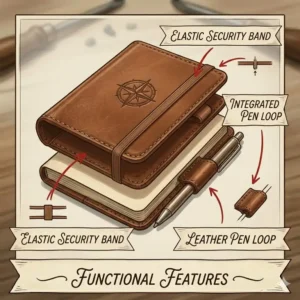
| Pen Loop | YES | Without it, you’ll constantly be hunting for a pen in your bag or pocket. |
| Hand-Stitching | YES | A saddle-stitch (done by hand) won’t unravel if one thread breaks; machine-locked stitches will. |
| Elastic Closure | MAYBE | Essential if you stuff receipts in your journal; annoying if you want a slim profile. |
| RFID Blocking | NO | It’s a notebook. Unless you’re storing credit cards inside, this is useless marketing fluff. |
| Gilt-Edges | NO | Looks pretty for a week, but the gold leaf flakes off in your pocket within a month. |
Long-Term Maintenance: Keeping Your Journal for Decades
If you’ve invested in a high-quality leather pocket journal, you shouldn’t have to replace it… ever. Here is my “Pro-Tip” for maintenance:
-
The “Towel Trick”: If your leather gets soaked in the rain, do NOT use a hairdryer. This will crack the fibers. Stuff the notebook with paper towels to hold the shape and let it air dry away from direct heat.
-
Cleaning Biofilm: After months of pocket carry, leather can feel “tacky” or sticky. Use a damp cloth with a tiny drop of mild dish soap to wipe the exterior, then immediately dry it. This removes the “pocket grime” without stripping the oils.
-
The 6-Month Oil: Every 6 months, apply a pea-sized amount of leather conditioner. If you use too much, the leather will become “mushy” and lose its structural integrity.
✨ Take Your EDC To The Next Level!
🔍 Ready to find your perfect match? Click on any of the products mentioned above to see the latest availability. Whether you’re a poet, a programmer, or a pilot, these journals are built to handle your story.

Conclusion: Finding Your Perfect Analog Companion
Choosing a leather pocket journal is a deeply personal decision that balances aesthetics, utility, and tactile preference. In my decade of testing, I’ve found that the most expensive option isn’t always the best—but the cheapest option is almost always a mistake.
If you want a rugged, “work-horse” feel that will survive a construction site, go with the Hide & Drink. For the professional who needs a slim, sophisticated tool for the boardroom, the Smythson or Field Notes covers are unbeatable. If you are like me and love the ritual of writing with a fountain pen, the Galen Leather system provides the structural support and paper quality you need.
Remember, the journal is just the vessel. The real value is in the thoughts, sketches, and memories you commit to the page. Over time, that leather will become a physical map of your life’s journey—and that is something a digital app can never replicate.
FAQs
❓ Does a leather pocket journal fit in front pockets?
✅ Most 3.5″ x 5.5″ models fit easily in standard men’s jeans and “boyfriend” style women’s jeans. However, if you wear “skinny” or slim-fit denim, you should look for “jacket-style” covers without elastics to keep the profile under 0.5 inches…
❓ Can I use a fountain pen in these journals?
✅ It depends on the paper insert, not the leather. Look for journals that include “Tomoe River” or “Clairefontaine” paper, or ensure the paper weight is at least 90-100 GSM to prevent feathering and bleed-through…
❓ How do I fix a scratch on my leather cover?
✅ For full-grain “pull-up” leather, simply rub the scratch vigorously with your warm thumb. The heat redistributes the natural oils and waxes, often making light scratches disappear completely within seconds…
❓ Are these journals waterproof?
✅ No leather is truly waterproof, but “Chrome-tanned” leather is highly water-resistant. If you work outdoors, I recommend applying a thin layer of beeswax-based conditioner to create a protective barrier against light rain…
❓ Is “Vegan Leather” better than real leather for journals?
✅ Most “Vegan Leather” is actually polyurethane (plastic), which cracks and ends up in a landfill within 2 years. For a sustainable option, look for “Vegetable-Tanned” real leather, which is a biodegradable byproduct of the food industry and lasts a lifetime…
Recommended for You
- 5 Best leather travelers notebook Options for 2026: Expert Field Guide
- 5 Best Pocket Notebook Cover Options for 2026: The Ultimate Guide
- 5 Best moleskine leather cover Options for 2026: Expert Reviews & Guide
Disclaimer: This article contains affiliate links. As an Amazon Associate, I earn from qualifying purchases. If you purchase products through these links, we may earn a small commission at no additional cost to you.
✨ Found this helpful? Share it with your friends! 💬🤗
[addtoany]
