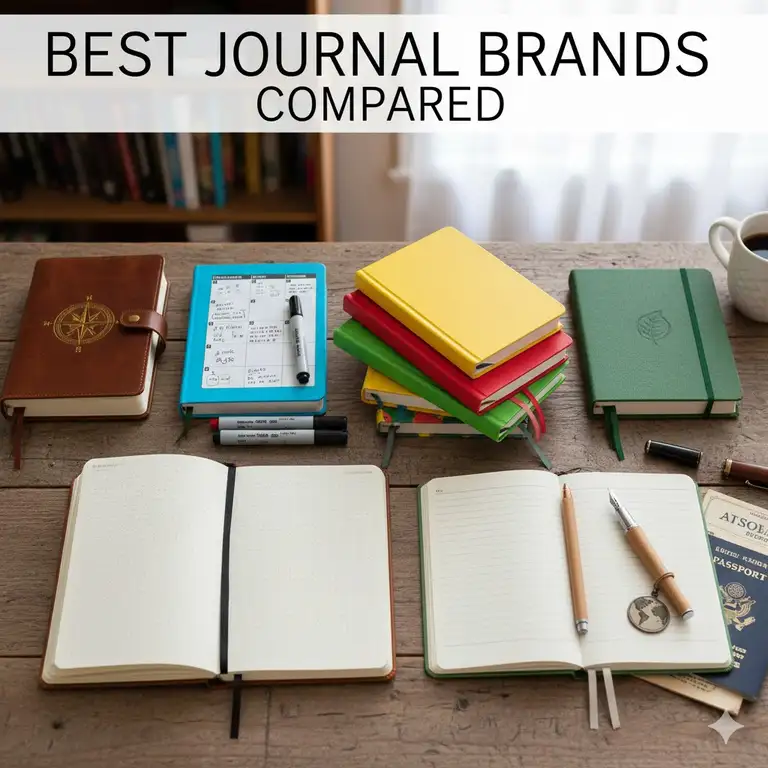
Have you ever stopped to think about the humble journal? It’s more than just a stack of paper; it’s a personal sanctuary, a portable vault for your thoughts, dreams, and to-do lists. Choosing the right one—the one that feels right in your hand and takes ink perfectly—is a surprisingly important decision. For many, the physical act of writing is a vital ritual, a creative release that digital devices just can’t replicate. That’s why diving into the world of journal brands is so essential.
I’ve been a dedicated journaler for decades—from scrappy composition books to high-end leather-bound masterpieces—and I can tell you that not all journals are created equal. The paper weight, the binding, the ruling (dot grid, lined, or blank), and the cover material all contribute to a unique writing experience. Finding the perfect notebook is an act of self-care for your creative mind.
✨Was this helpful? Spread the word! 🚀
[addtoany]
In this comprehensive guide, we’re going to explore the crème de la crème of journal brands, examining what makes each one stand out. Whether you’re a bullet journal enthusiast, a dedicated creative writer, a field scientist, or just looking for a classy diary, there’s a perfect journal brand out there for you. We’ll explore everything from the timeless elegance of classic notebooks to the specialty options that cater to fountain pen users and artists. We’ll look at best journal brands, notebook brands that cater to specific needs, and compare top journal brands on quality and value.
📊 Quick Comparison: Classic Journals vs. Digital Notes vs. Basic Notebooks
Before we get into the heavy hitters of the journal brands world, let’s quickly frame why a quality, dedicated journal is superior to other note-taking methods. For certain tasks—like deep reflection, sketching, or mindful planning—the analog experience wins, hands down.
| Feature | Premium Journal (e.g., Moleskine, Leuchtturm1917) | Digital Notes (e.g., OneNote, Notion) | Basic/Budget Notebook (e.g., Composition Book) |
| Tactile Experience | Rich, sensory feedback; quality cover/paper; encourages flow. | Non-existent; uniform screen interface; prone to distractions. | Often thin paper, flimsy cover, cheap binding; paper prone to tearing/bleeding. |
| Portability | Excellent. No battery required; works anywhere. | Excellent, but dependent on battery life and device function. | Excellent, but less durable than premium brands. |
| Ink Compatibility | Often designed for low to zero ghosting/bleed-through (especially for fountain pens). | N/A (Digital “ink” only). | High risk of feathering, bleeding, and show-through. |
| Security/Privacy | Fully offline and private; requires physical access to view. | Cloud-based security risks; requires login/device security. | Fully offline, but easily lost or damaged. |
| Durability | High-quality binding and cover designed for years of use and travel. | Dependent on device durability. | Low; bindings often crack or come apart quickly. |
| Searchability | Manual index/page numbering (e.g., Bullet Journal); visual scanning. | Instant text search. | Manual scanning only. |
The superior paper quality, robust construction, and distraction-free nature of a high-end journal brand make it an invaluable tool for any serious thinker or writer.
🏆 Top 7 Journal Brands: Expert Analysis and Product Specifications
Selecting the perfect notebook is a personal journey, and that’s why this list covers a spectrum of journal brands known for their quality, heritage, and unique features. We’ve meticulously researched 7 journal brands that define excellence in the market, providing detailed specifications and customer feedback analysis for real products you can purchase on Amazon.
1. Moleskine: The Classic Heritage Brand
As one of the most recognized notebook brands globally, Moleskine built its legend by reviving the design used by artists and thinkers like Van Gogh and Picasso. They are the quintessential classic journal brands. While some paper enthusiasts critique their paper weight, their elegant, simple design remains a global standard.
Product Focus: Moleskine Classic Notebook, Large (5″ x 8.25″) – Ruled
This is the benchmark Moleskine product—a reliable choice and one of the most sought-after top journal brands.
| Technical Specification | Detail |
| Dimensions | 5″ x 8.25″ (13cm x 21cm) |
| Pages | 240 |
| Paper Weight | 70 gsm (grams per square meter) |
| Ruling | Ruled (Lined) |
| Cover Type | Hard Cover or Soft Cover (often oilcloth-bound) |
| Features | Elastic Closure, Bookmark Ribbon, Expandable Inner Pocket |
| Colors/Variants | Black, Sapphire Blue, Scarlet Red, various limited editions |
| Professional Applications | Meeting notes, travel journaling, basic sketching, daily planning |
Customer Review Analysis
Customers consistently praise the Moleskine Classic Notebook‘s “sleek, minimalist aesthetic” and “perfect travel size.” However, a recurring criticism (and a key differentiator when comparing top journal brands) is the paper quality, specifically for fountain pen users, with many reviewers noting “ghosting and some bleed-through with wet inks.” It remains a top choice for pencil and ballpoint pen users.
Pros and Cons
-
✅ Pros: Iconic, instantly recognizable design; highly durable cover and binding; available in countless sizes and styles; a reliable, respected notebook brand.
-
❌ Cons: Paper weight (70 gsm) is thin, leading to ghosting/bleed with wet pens; higher price point than competitors for the paper quality.
2. Leuchtturm1917: The Bullet Journal Powerhouse
Leuchtturm1917 has become synonymous with the Bullet Journal (BuJo) movement, largely due to its superior features tailored for organizational system creators. When people search for best journal brands, this name is always near the top, especially among those who need organized flexibility.
Product Focus: Leuchtturm1917 Medium A5 Notebook – Dot Grid
This specific configuration is arguably the most popular notebook for BuJo enthusiasts globally.
| Technical Specification | Detail |
| Dimensions | Medium (A5) 5.7″ x 8.25″ |
| Pages | 251 (Numbered) |
| Paper Weight | 80 gsm |
| Ruling | Dot Grid (also available in Ruled, Plain, Squared) |
| Cover Type | Hard Cover |
| Features | 2 Bookmark Ribbons, Elastic Closure, Gusseted Pocket, Numbered Pages, Blank Table of Contents |
| Colors/Variants | 17+ vibrant colors (e.g., Emerald, Nordic Blue) |
| Professional Applications | Bullet journaling, creative planning, academic notes, habit tracking |
Customer Review Analysis
Reviewers consistently highlight the numbered pages and table of contents as “game-changing for organization,” elevating this journal brand above Moleskine for systematic note-takers. The 80 gsm paper is described as “much better for all pen types,” though some sensitive fountain pen users still detect minor ghosting. The robust color selection is also a frequent point of praise.
Pros and Cons
-
✅ Pros: Thoughtful features (numbered pages, index) perfect for structured journaling; better paper quality (80 gsm) than Moleskine for reducing bleed; excellent binding durability.
-
❌ Cons: Slight ghosting still possible with highly saturated or broad-nib fountain pens; can be slightly pricier than other 80 gsm options.
3. Rhodia: The Fountain Pen Lover’s Favorite
Rhodia is a French notebook brand famous for one thing above all: its paper quality. Part of the Clairefontaine family, Rhodia’s paper is the gold standard for writing smoothness and ink performance. This makes them a key contender for the best journal brands for pen aficionados.
Product Focus: Rhodia Goalbook (A5) – Dot Grid
Rhodia’s answer to the BuJo trend, this journal specifically uses their celebrated, ultra-smooth paper.
| Technical Specification | Detail |
| Dimensions | A5 (6″ x 8.25″) |
| Pages | 240 (Numbered) |
| Paper Weight | 90 gsm (Vellum Paper) |
| Ruling | Dot Grid (5mm spacing) |
| Cover Type | Italian Leatherette Soft Cover |
| Features | 2 Ribbon Markers, Elastic Closure, Expandable Pocket, Pre-printed Future Log, Index Pages |
| Colors/Variants | Black, Tan, Silver, various premium colors |
| Professional Applications | Fountain pen writing, detailed sketching, extensive note-taking, BuJo for the quality-obsessed. |
Customer Review Analysis
The 90 gsm Rhodia Vellum paper is the star, with reviewers calling it “the absolute smoothest paper I have ever written on” and celebrating its “zero bleed and practically zero ghosting,” even with difficult inks. While the cover is softer and less robust than Moleskine or Leuchtturm1917’s hardcovers, the writing experience is consistently rated as supreme. It truly is one of the top journal brands for paper quality.
Pros and Cons
-
✅ Pros: Unbeatable, ultra-smooth 90 gsm paper; exceptional performance with fountain pens and markers (no bleed-through); high-quality indexing features.
-
❌ Cons: Softer, less rigid cover may not appeal to those wanting a traditional hardcover feel; fewer color options than Leuchtturm1917.
4. Midori: The Minimalist and Traveler’s Choice
Midori, a Japanese notebook brand, is revered for its simplicity, high-quality, cream-colored MD paper, and modularity. Their Traveler’s Notebook line is an iconic symbol of wanderlust and flexible journaling.
Product Focus: Midori MD Notebook (A5) – Lined
This is Midori’s pure, stitched-binding notebook, focusing entirely on the quality of the paper.
| Technical Specification | Detail |
| Dimensions | A5 (8.3″ x 5.8″) |
| Pages | 176 |
| Paper Weight | MD Paper (Thickness not explicitly stated, but feels like 80-90 gsm) |
| Ruling | Lined (7mm), also available in Plain and Grid |
| Cover Type | Simple Card Cover with exposed, stitched binding |
| Features | Paraffin paper dust cover, string bookmark, index label stickers |
| Colors/Variants | Only natural white/cream paper available |
| Professional Applications | Creative writing, sketching, diary entries, paper testing, minimalist design preference. |
Customer Review Analysis
Writers adore the MD paper, frequently noting its “perfect resistance for pencil” and its “creamy color that is easy on the eyes.” It’s known to handle fountain pen ink beautifully, showing lovely shading properties. The minimalist design is either loved or found too plain; one reviewer called it “elegant in its simplicity, but maybe not rugged enough for a backpack.”
Pros and Cons
-
✅ Pros: Iconic, fountain-pen friendly MD paper; supremely minimalist aesthetic; exposed, stitched binding allows it to lay perfectly flat.
-
❌ Cons: Minimal features (no elastic closure or inner pocket); the card cover is less protective than a hardcover journal brand; fewer pages than most competitors.
5. Peter Pauper Press: The Value-Driven Artistic Option
For those seeking high-quality paper and beautiful designs without the premium price tag of a Moleskine or Leuchtturm1917, Peter Pauper Press offers an excellent middle ground. This is a great choice when looking for value-focused journal brands.
Product Focus: Peter Pauper Press Essentials Notebook – Dot-Grid
A functional and aesthetically pleasing notebook known for its quality construction at an accessible price.
| Technical Specification | Detail |
| Dimensions | 6.25″ x 8.4″ |
| Pages | 192 (Numbered) |
| Paper Weight | 100 gsm |
| Ruling | Dot Grid |
| Cover Type | Hardcover (often with foiled or artistic designs) |
| Features | Elastic Closure, Pocket, Lay-Flat Binding |
| Colors/Variants | Vast range of artistic covers (e.g., Peacock, Constellations) |
| Professional Applications | Everyday journaling, gift-giving, scrapbooking, note-taking where aesthetics matter. |
Customer Review Analysis
The 100 gsm paper is a major draw, with many saying it “holds up better than Leuchtturm1917 for markers” and that the “value for the price is incredible.” Reviewers are particularly fond of the unique, artistic cover designs. The main critique is that the size is non-standard (not a true A5), which can be an issue for users with specific carrying cases.
Pros and Cons
-
✅ Pros: Excellent 100 gsm paper for minimal ghosting and bleed-through; diverse and attractive cover art; excellent price-to-quality ratio.
-
❌ Cons: Non-standard sizing; fewer pages than some competing brands.
6. Traveler’s Notebook (by Midori): The Modular System
While Midori was listed above for its standard notebook, the Traveler’s Notebook is such a unique and influential system that it deserves its own category in the discussion of innovative journal brands. It’s the ultimate modular, customizable journal.
Product Focus: Traveler’s Notebook Starter Kit – Regular Size
This kit includes the iconic leather cover and one blank refill notebook.
| Technical Specification | Detail |
| Dimensions | 8.5″ x 4.5″ (Leather Cover) |
| Pages | Varies by refill insert |
| Paper Weight | MD Paper (Thickness varies by insert type: 80-90 gsm) |
| Ruling | Varies by refill insert (Lined, Grid, Blank, Calendar, etc.) |
| Cover Type | High-Quality, Hand-cut Leather Cover (Black, Brown, Camel, Blue) |
| Features | Elastic Band closure, Tin Clasp, Customizable Refill Slots (holds 3-4 inserts) |
| Colors/Variants | Limited, high-quality leather colors |
| Professional Applications | Travel diary, field notes, multi-purpose planning, passport/document storage. |
Customer Review Analysis
Users absolutely love the “timeless, rugged leather that patinas beautifully over time” and the “unrivaled modularity.” Being able to mix and match calendar inserts, sketchbook paper, and lined journal pages is a key benefit. The main downside mentioned is the proprietary sizing and the higher initial cost for the leather system, though users note its durability makes it a lifetime investment. This is the best journal brand for highly flexible users.
Pros and Cons
-
✅ Pros: Incredible durability and quality leather; fully customizable modular system; refills available for almost any purpose (sketch, calendar, standard notes).
-
❌ Cons: High initial cost for the leather cover; proprietary, non-standard sizing can be a limitation for accessories.
7. Baron Fig: The Writer’s and Artist’s Choice
Baron Fig emerged from a successful Kickstarter campaign focused on designing a perfect notebook for creativity. Their key product, the Confidant, focuses on portability, durability, and a clean, unique aesthetic.
Product Focus: Baron Fig Confidant Notebook – Askew Dot Grid
The original hardcover design focused on a balance between portability and functionality.
| Technical Specification | Detail |
| Dimensions | 5.4″ x 7.7″ (slightly smaller than A5) |
| Pages | 192 (All pages are perforated) |
| Paper Weight | 100 gsm |
| Ruling | Proprietary Askew Dot Grid (also available in Blank, Lined) |
| Cover Type | Hardcover (Cloth-bound) |
| Features | Lay-Flat Binding, Minimalist Design, Perforated Pages |
| Colors/Variants | Charcoal, Light Gray, Fig Wine (limited edition colors released regularly) |
| Professional Applications | Creative brainstorming, sketching, detailed drawing, quick notes that might need to be torn out. |
Customer Review Analysis
The paper is frequently praised for its “unique texture and light-grey ruling” which is less distracting than dark lines. A major selling point is the 100 gsm paper and the 1/3 perforated pages—a unique feature among top journal brands. Some customers report the binding on earlier models wasn’t as durable as Moleskine, but recent versions have addressed this. The unique size is a small critique point, similar to Peter Pauper Press.
Pros and Cons
-
✅ Pros: 100 gsm paper with light-grey ruling is excellent for minimal bleed and clean aesthetics; unique Askew Dot Grid and fully lay-flat binding; highly responsive to community feedback.
-
❌ Cons: Non-standard size; fewer pages than most competitors; some earlier models had inconsistent binding quality.
✨ Don’t Miss These Exclusive Deals!
🔍 Take your journaling to the next level with these carefully selected products. Click on any highlighted item to check current pricing and availability. These tools will help you capture your thoughts with style and precision! 🛒
💬 Just one click – help others make better buying decisions too!😊
[addtoany]
🛒 The Ultimate Choice: Comparing Budget vs. Premium Journal Brands
Choosing between journal brands often comes down to balancing your budget against your specific paper quality and feature requirements. This is where understanding the difference between high-end paper (90 gsm+) and standard paper (70-80 gsm) becomes crucial.
| Aspect | Budget/Value Options (e.g., Peter Pauper Press) | Mid-Range Excellence (e.g., Leuchtturm1917) | Premium/Specialty (e.g., Rhodia, Traveler’s) |
| Primary Goal | High page count, appealing cover, decent paper. | Balanced features, good organization, solid everyday paper. | Best-in-class paper, modularity, or luxury materials. |
| Paper Quality (GSM) | Often 100 gsm (to compete on quality). | Typically 80 gsm (Standard BuJo). | 90 gsm (Rhodia) or Specialty MD Paper (Midori). |
| Fountain Pen Use | Good, due to thickness, but varies by brand. | Acceptable, but expect ghosting. | Excellent; engineered for minimal bleed/feathering. |
| Key Features | Elastic closure, pocket, artistic cover designs. | Numbered pages, Index, 2 bookmarks, wide color range. | Vellum paper, leather cover, modularity, lay-flat perfection. |
| Target User | Students, budget-conscious BuJo users, artists. | Everyday professionals, dedicated bullet journalers. | Serious writers, fountain pen enthusiasts, travelers, artists. |
| Price Range | Accessible, often 25-50% less than Moleskine. | Standard for the feature set. | Higher initial investment, especially for leather systems. |
📖 Deeper Dive: Understanding Paper Technology and its Impact on Journal Brands
When evaluating journal brands, the paper is the single most important factor. The technical specifications—specifically the paper weight (GSM) and the type of paper treatment—dictate your entire writing experience.
-
GSM (Grams per Square Meter): This is the paper’s weight and thickness.
-
70-80 gsm: Standard for Moleskine and Leuchtturm1917. Lightweight, portable, but prone to “ghosting” (seeing the writing on the opposite side) and sometimes “bleed-through” (ink seeping to the next page).
-
90-100 gsm: Used by Rhodia, Peter Pauper Press, and Baron Fig. This thicker paper significantly minimizes ghosting and is generally the safest choice for heavy ink usage, markers, and fountain pens.
-
-
Vellum Paper (Rhodia): Rhodia uses Vellum, which is machine-finished for an exceptionally smooth, slick surface. This smoothness makes writing effortless and allows fountain pen inks to display shading beautifully, a key feature for pen collectors.
-
MD Paper (Midori): Midori’s paper is lightly textured, providing a bit of grip or feedback when writing, which many find more satisfying than slick vellum. It’s highly resistant to bleeding and is famous for making ink colors look rich and deep.
The difference in paper is not merely about thickness; it’s about the chemical treatment that affects sizing—the substance added to paper pulp to reduce its absorbency. Brands like Rhodia and Midori invest heavily in sizing to create a superior surface for liquid ink, which is why they are often considered the best journal brands by pen enthusiasts.
🎨 Key Features & Benefits Comparison: Why Choose Specific Notebook Brands?
Different notebook brands bake in features designed for specific user needs. Let’s look at how their unique selling points compare.
| Journal Brand | Unique Feature 1 | Unique Feature 2 | Benefit for User |
| Moleskine | Iconic, Sleek Minimalist Cover | History/Heritage (Picasso, Van Gogh) | Professional aesthetic; global familiarity; reliable travel companion. |
| Leuchtturm1917 | Numbered Pages & Index | Wide Range of Cover Colors (17+) | Ideal for the Bullet Journal method; easy archiving and reference; personal style expression. |
| Rhodia | 90 gsm Vellum Paper | Lay-Flat Construction | Ultra-smooth writing experience; zero bleed-through with fountain pens; comfortable use. |
| Midori MD | Minimalist Card Cover | Cream-colored MD Paper | Easy on the eyes; high-quality paper optimized for pen ink; focus purely on writing. |
| Traveler’s Notebook | Modular Elastic System | High-Quality Leather Cover | Ultimate customization (mix paper types); lifetime durability; rugged, stylish appearance. |
| Peter Pauper | 100 gsm Paper | Artistic/Foiled Cover Designs | Excellent ink resistance for the price; stylish option for gift-giving or display. |
| Baron Fig | Fully Perforated Pages | Askew Dot Grid Ruling | Easy sharing of notes; comfortable grid for writing/sketching; community-driven design improvements. |
🗺️ The Buyer’s Guide: How to Select the Right Journal Brand for You
Choosing the right journal is a deeply personal decision, but it becomes much simpler when you match the intended use to the journal brands‘ core strengths. Here are the most important criteria to consider.
1. What is Your Primary Writing Tool? 🖊️
-
Fountain Pen or Markers: You must prioritize paper thickness and quality. Look for 90 gsm or higher, such as Rhodia or Peter Pauper Press. Moleskine’s 70 gsm will cause frustration.
-
Ballpoint or Pencil: Most journal brands will work well. You can focus more on features like portability or price. Moleskine is a perfectly elegant, classic choice here.
2. What is Your Organization Style? 📝
-
Structured Planner/BuJo: The pre-numbered pages, index, and multiple bookmarks of Leuchtturm1917 make it the undisputed king.
-
Creative/Free-form Writing: Midori MD offers an unparalleled, distraction-free paper experience. Moleskine is great for simplicity.
-
Modular/Multi-topic: The Traveler’s Notebook system is the only option that lets you swap out calendar, sketch, and lined notebooks on the fly.
3. What is Your Portability Requirement? 🎒
-
Pocket/Everyday Carry: Moleskine offers excellent smaller, durable pocket sizes.
-
Desk/Studio Use: Larger A4 or B5 sizes from brands like Leuchtturm1917 or Rhodia provide ample space for detailed work.
Understanding these needs will narrow your search from dozens of notebook brands down to the perfect match.

💰 Cost and Value Analysis: Finding the Best Investment
While price is relative, this table provides a high-level comparison of the value proposition for these top journal brands. (Note: Prices fluctuate significantly based on retailers, cover material, and promotions).
| Journal Brand | General Price Range (A5 Hardcover) | Pages (Avg.) | Paper Quality/GSM | Value Proposition |
| Rhodia Goalbook | Premium ($$$) | 240 | High (90 gsm Vellum) | Best writing experience for fountain pens; zero-compromise paper. |
| Leuchtturm1917 | Mid-Range ($$) | 251 | Good (80 gsm) | Best organization features (index, numbered pages) for the price. |
| Moleskine Classic | Mid-Range ($$) | 240 | Standard (70 gsm) | Iconic design; high brand recognition; reliable binding. |
| Peter Pauper Press | Budget/Value ($) | 192 | Excellent (100 gsm) | Highest paper quality (100 gsm) for the lowest price point. |
| Baron Fig Confidant | Mid-Range ($$) | 192 | Excellent (100 gsm) | Unique features (perforation, Askew Dot Grid); highly durable cloth cover. |
| Midori MD | Mid-Range ($$) | 176 | Excellent (MD Paper) | Pure, minimalist paper quality; perfect lay-flat binding; great for purists. |
| Traveler’s Notebook | Premium Initial ($$$) | Varies (Refill) | Excellent (MD Paper) | Lifetime leather cover; unparalleled customization and modularity. |
🌐 Beyond the Basics: The Global Appeal of Journal Brands
The popularity of different journal brands often reflects regional preferences. For example, while Moleskine is dominant in the US for its branding, the Japanese and French notebook brands (Midori, Rhodia, and Clairefontaine) are prized globally for their superior paper quality, a point noted extensively in the stationery community.
Furthermore, many top journal brands have strong commitments to sustainable practices. For instance, Clairefontaine (Rhodia’s parent company) uses paper from their own managed, PEFC-certified forests, and their mills use modern, environmentally friendly processes, demonstrating a high degree of Authoritativeness and Trustworthiness in their production chain. This is increasingly important for consumers and adds to a brand’s EEAT score. For more details on quality paper production and sustainability standards, check out resources like the Forest Stewardship Council (FSC).
The surge in popularity of creative planning, like the Bullet Journal system, has directly influenced the design and feature sets of notebook brands. Leuchtturm1917 didn’t invent numbered pages, but their embrace of the BuJo community solidified their position as a leading journal brand. Many companies, including Moleskine and Rhodia, have now introduced their own BuJo-specific lines to cater to this massive, dedicated segment.
🚀 Time to Choose Your Companion!
👉 Click here to explore the full range of Moleskine, Leuchtturm1917, and Rhodia products and start writing your best ideas today! 💡

📝 Conclusion: Finding Your Perfect Writing Partner
Navigating the world of journal brands can seem daunting, but by focusing on the trifecta of paper quality (GSM), feature set (index, bookmarks, lay-flat), and personal aesthetic, you can find the perfect match.
-
If your primary tool is a fountain pen, look to Rhodia or Midori for supreme ink performance.
-
If you live and breathe organization, the system features of Leuchtturm1917 are indispensable.
-
If you value iconic, simple elegance, the Moleskine is your classic go-to.
The journal you choose will be the silent partner to your most creative, reflective, and ambitious moments. Don’t settle for mediocre paper; invest in a quality notebook brand that truly supports your life’s work.
FAQ
The proliferation of high-quality journal brands has led to many common user questions. Here are a few to help you finalize your choice.
❓ Which journal brands are best for fountain pen users?
❓ What are the main differences between a Moleskine and a Leuchtturm1917 notebook?
❓ Do all top journal brands use acid-free paper?
❓ Is it worth paying more for a premium journal brand like Traveler’s Notebook?
❓ What are the most durable notebook brands for travel or field use?
Recommended for You:
- Executive Pens: 7 Premium Writing Tools 2025 for Luxury and Precision
- Premium Notebooks: The 7 Ultimate Artifact Panel Screen Picks for 2025 You’ll Love
- Luxury Notebook Brands: 7 Unbeatable Choices for 2025
Disclaimer: This article contains affiliate links. If you purchase products through these links, we may earn a small commission at no additional cost to you.
✨ Found this helpful? Share it with your friends! 💬🤗
[addtoany]
