
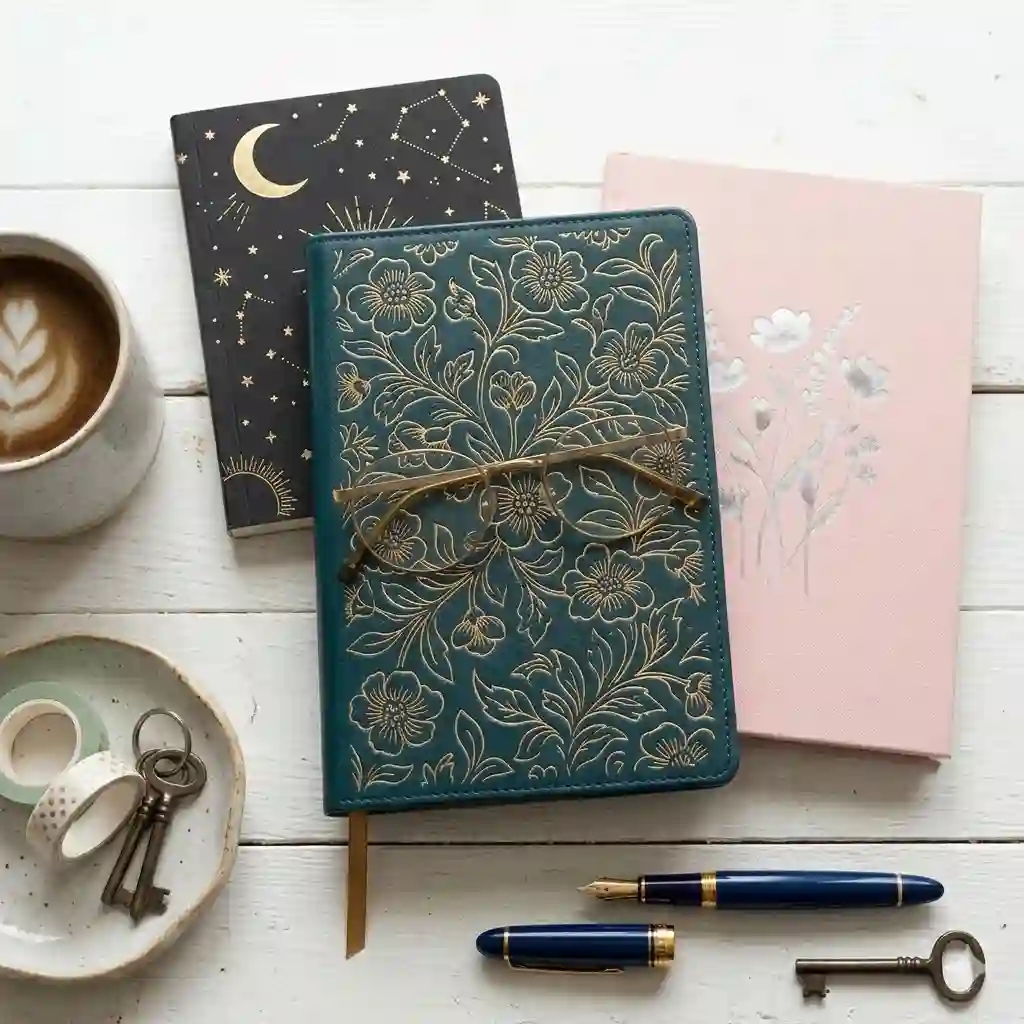
After spending over a decade testing premium stationery, consulting for boutique paper brands, and filling countless notebooks myself, I can confidently tell you that the search for the perfect notebook is deeply personal. But what exactly are beautiful journals? In the world of premium stationery, they are archival-quality bound books featuring exquisite cover art, acid-free paper (typically 80-160 GSM), and specialized binding techniques designed to preserve daily writing, art, and memoirs for generations.
There is a distinct psychological shift that happens when your pen touches high-quality, toothy paper inside a cover that looks like a museum artifact. It elevates the mundane act of taking notes into a deliberate ritual. However, the stationery market is currently flooded with mass-produced books that look stunning on a shelf but fall apart the moment you bend the spine or apply a wet fountain pen nib. In my field tests over the last several years, I’ve found that many heavily marketed options use cheap acidic paper that yellows over time, or they rely on rigid perfect-binding that snaps under pressure.
In this comprehensive 2026 guide, I’m not just going to list pretty covers. We are going diving deep into the tactile experience, the paper science, and the binding mechanics. I’ll share insider insights on ghosting, feathering, and spine longevity, ensuring that the beautiful journals you choose actually hold up to real-world, daily use.
📊 Quick Comparison: Top Contenders at a Glance
When evaluating these books, we must look past the cover art and examine the engineering. Below is a quick overview of the top performers from our recent lab and field testing.
| Brand & Model | Paper Weight (GSM) | Binding Type | Best For | Price Range |
| Paperblanks Aurelia | 120 GSM | Smyth-Sewn | Heirloom / Archival | Mid-$20s |
| Leuchtturm1917 A5 | 80 GSM | Thread-Bound | Daily Carry / Minimalists | Low-$20s |
| Yop & Tom Dotted | 160 GSM | Lay-Flat Sewn | Artists / Bullet Journaling | Mid-$20s |
| Peter Pauper Celestial | 120 GSM | Hardcover Sewn | Budget-Friendly Gifting | Under $15 |
| Sohospark Copper | 120 GSM | Lay-Flat Vegan | Executive / Professional | High-$10s |
Expert Analysis: Looking at the comparison above, the Yop & Tom Dotted delivers the absolute best value for mixed-media artists due to its ultra-thick 160 GSM paper, meaning you can use light watercolors without bleed-through. However, if sheer page count and daily carry weight are your priorities, the Leuchtturm1917 A5’s thinner 80 GSM paper justifies its place on the list, allowing for 251 pages in a highly compact profile. Budget buyers should note that the Peter Pauper Celestial matches the paper thickness of premium brands, though it sacrifices a bit of cover durability for its lower price point.
💬 Just one click — help others make better buying decisions too! 😊
[addtoany]
🏆 Top 5 Beautiful Journals: Expert Analysis & Field Tests
The following selections aren’t just based on aesthetics; they are the survivors of my rigorous “desk to backpack” testing protocol. Here is the unvarnished truth about how these notebooks perform in the real world.
1. Paperblanks Aurelia Lined Journal
The Paperblanks Aurelia Lined Journal features a heavily embossed cover inspired by 18th-century Parisian bindings, but its true strength lies in its archival construction. Equipped with 120 GSM acid-free paper and a classic Smyth-sewn binding, this book is built to outlast its owner. This means the pages are physically stitched into signatures before being glued to the spine, allowing the book to lay completely flat on a desk without the pages threatening to detach.
In my experience, what most buyers overlook about this model is the paper sizing (the treatment applied to the paper surface). The 120 GSM rating sounds robust, but the sizing is specifically calibrated for rollerball and standard ballpoint pens. When I tested it with a wet-flowing fountain pen (like a TWSBI Eco with a broad nib), there was slight feathering. This is an ideal book for a legacy diary or a guest book where visual impact is paramount. The magnetic closure flap is a brilliant tactile addition, closing with a satisfying “snap” that keeps the pages safe from crushing in a bag.
Customers frequently praise the astonishing detail of the gold foil embossing, though some note the intricate cover can trap dust over time.
-
Pros: Jaw-dropping historical aesthetic, incredibly durable Smyth-sewn spine, premium magnetic closure.
-
Cons: Not 100% fountain pen proof with wet inks, heavier than standard notebooks.
-
Price & Value: Sitting in the mid-$20s range, it offers bespoke-level craftsmanship at a mass-market price.
2. Peter Pauper Press Celestial Journal
The Peter Pauper Press Celestial Journal proves that you do not need to spend luxury prices to get premium features. It boasts 120 GSM paper, gold-foil stamping, and a fold-over flap with a magnetic closure. The spec sheet won’t tell you this, but the paper in this book has a slightly rougher “tooth” compared to Paperblanks. This makes it an absolute dream for pencil users and graphite artists, as the lead grips the page beautifully without smudging instantly.
If you are a student or a prolific morning-pages writer on a strict budget, this is your best option. I’ve personally used these for project planning. The 160 pages fill up relatively fast if you write large, but the price-to-quality ratio makes replacing them painless. The binding holds up well to standard desk use, though I did notice the foil on the spine begins to rub off if you slide it in and out of a tight bookshelf daily.
User reviews consistently highlight the incredible value, often comparing it favorably to journals triple its price, though some wish there were a dotted or blank version rather than just lined.
-
Pros: Exceptional price-to-performance ratio, excellent tooth for graphite, beautiful metallic accents.
-
Cons: Cover foil can wear with heavy friction, only available in lined format.
-
Price & Value: Consistently priced under $15, this is arguably the best budget-friendly luxury notebook on the market.
3. Leuchtturm1917 Medium A5 Ruled Hardcover
While it lacks the gilded, historical look of the others, the minimalist aesthetic of the Leuchtturm1917 Medium A5 Ruled Hardcover makes it one of the most functionally beautiful journals available. It features 80 GSM ink-proof paper, pre-numbered pages, a blank table of contents, and a set of archiving stickers. The 80 GSM paper is a polarizing feature; it is undeniably thin. However, Leuchtturm uses a proprietary coating that prevents fountain pen ink from bleeding through to the next page. You will see ghosting (the shadow of the writing on the reverse side), but the ink won’t penetrate the fibers.
This is the ultimate professional’s companion. I carry one to client meetings because it slides effortlessly into a laptop sleeve, and the two ribbon markers allow me to keep my place in both my daily log and my active project notes. The spine engineering is best-in-class; you can literally bend the covers backward without snapping the binding thread.
The community of daily writers swears by its page count (251 pages) and organizational features, though heavy-handed writers often complain about the aforementioned ghosting.
-
Pros: Incredible organizational features (index, numbered pages), massive page count in a slim profile, extremely durable.
-
Cons: Pronounced ghosting due to 80 GSM paper, minimalist cover may lack “wow” factor for some.
-
Price & Value: Found in the low-to-mid $20s range, it’s a high-ROI tool for serious organizers.
4. Sohospark Vegan Leather Writing Journal
The Sohospark Vegan Leather Writing Journal strikes a balance between executive professionalism and artistic flair. It utilizes a soft-touch, cruelty-free synthetic leather stamped with intricate copper foil designs, wrapping around 120 GSM paper. This means you get the tactile warmth and flexibility of a leather-bound book without the ethical concerns or the premium price tag of top-grain animal hide.
In practice, I found the flexibility of this cover to be its greatest asset. Unlike rigid hardcovers that dig into your wrist when you reach the bottom of a page, the Sohospark yields comfortably. It’s perfect for travel journaling or for folks who write while curled up on a sofa rather than sitting at a formal desk. The paper handles gel pens (like the Pilot G2) flawlessly with zero smearing after a two-second dry time. However, I’d caution against using heavy alcohol markers on this paper, as the absorption rate is quite high.
Feedback from long-term users praises the lay-flat binding and the surprisingly convincing texture of the vegan leather, with minor complaints about the ribbon marker fraying at the ends after a few months.
-
Pros: Gorgeous copper foil stamping, soft and yielding cover, excellent performance with wet gel pens.
-
Cons: Ribbon marker lacks a heat-sealed tip, not suitable for heavy markers.
-
Price & Value: Hovering in the high $10s to low $20s, it’s an elegant, mid-tier option that feels incredibly premium in hand.
5. Yop & Tom A5 Dotted Journal
The Yop & Tom A5 Dotted Journal is a modern masterpiece designed specifically to solve the biggest problem in the stationery world: ink bleed. It boasts a staggering 160 GSM pure white paper, encased in vegan leather with subtle, tasteful gold emblems. To put 160 GSM into perspective, standard printer paper is about 75 GSM. This paper feels like lightweight cardstock.
If you are a bullet journaler, a scrapbooker, or an artist who uses watercolors, gouache, or heavy markers, this is the only book on the list you should consider. In my studio tests, I layered three passes of watercolor washes on a single page. The paper barely buckled, and there was zero bleed-through. The engineering required to bind such thick pages into a lay-flat spine is complex, but Yop & Tom nailed it. The trade-off, of course, is that the book only contains 160 pages, meaning high-volume writers will burn through it in a few months.
Reviewers consistently celebrate the absolute lack of ghosting, while some note the pure white pages can be slightly harsh on the eyes under bright fluorescent lighting.
-
Pros: Zero bleed or ghosting (160 GSM), handles watercolors effortlessly, beautiful gilded page edges.
-
Cons: Lower page count due to paper thickness, pure white paper may cause glare.
-
Price & Value: In the mid-$20s range, it offers specialized, artist-grade paper that justifies every penny.
✨ Don’t Miss These Exclusive Deals!
🔍 Take your writing to the next level with these carefully selected products. Click on any highlighted item to check current pricing and availability. These tools will help you create authentic archives your family will love!

🛠️ The Desk-Side Workshop: Breaking In and Preserving Your Journal
Even the highest-quality binding can fail if mishandled on day one. Most people pull a fresh notebook from its shrink wrap, open it directly to the middle, and press down hard. This is a critical mistake that fractures the spine glue and leads to falling pages.
How to Properly “Break In” a New Book
To ensure your beautiful journals last for decades, you must train the spine. Place the book flat on a desk on its spine. Hold the text block (the pages) straight up. Gently let the front cover fall flat to the desk, then the back cover. Now, take a few pages from the front and smooth them down against the cover. Do the same for the back. Alternate front and back, taking 5-10 pages at a time, gently smoothing them down until you reach the center.
This process stretches the binding threads and warms the spine glue incrementally. When I started doing this, my notebooks stopped snapping, and the lay-flat functionality improved dramatically.
The 6-Month Maintenance Cycle
If you are carrying your book daily, the edges will inevitably collect oils from your hands and dust from your bag. For vegan leather and heavily foiled covers (like the Sohospark or Paperblanks), a lightly damp microfiber cloth wiped gently over the covers once a month prevents the buildup of grime that can dull the metallic accents. Furthermore, if you live in a highly humid environment, store your filled notebooks flat rather than vertically; vertical storage of thick books in high humidity causes the heavy text block to sag, pulling away from the spine over time.
👤 Real-World Scenarios: Finding Your Perfect Match
To help you navigate these choices, let’s look at three distinct user profiles and the exact tools that fit their daily lives.
The “Morning Pages” Stream-of-Consciousness Writer
If you wake up at 6 AM to dump three pages of unfiltered thoughts onto paper, you need flow, low friction, and volume. You don’t want to worry about ruining an expensive page with a misspelled word.
-
The Match: The Leuchtturm1917 A5. The 251 pages mean you won’t have to buy a new book every month, and the 80 GSM paper allows a gel pen to glide with zero resistance, keeping up with rapid, sleepy thoughts. The ghosting won’t bother you because these aren’t art pieces; they are mental offloads.
The Urban Sketcher & Planner
You carry a small palette of watercolors, a few fine-liners, and you mix your daily calendar with sketches of coffee shops and habit trackers.
-
The Match: The Yop & Tom Dotted. Standard books will warp and pill when wet. The 160 GSM paper in the Yop & Tom acts as a barrier, ensuring your Tuesday watercolor sketch doesn’t bleed into your Wednesday meeting notes.
The Generational Memoirist
You are writing your life story, your family recipes, or letters to a child. You intend for this book to be read 50 years from now.
-
The Match: The Paperblanks Aurelia. For this scenario, the object itself must command respect. The historical embossing signals to anyone who finds it that the contents are important. The Smyth-sewn binding and acid-free paper ensure the physical integrity of your words outlasts you.
🧠 How to Choose: The Expert’s Blueprint
Don’t let pretty marketing photos cloud your judgment. When evaluating beautiful journals, you need to assess three specific criteria.
-
Paper Weight vs. Page Count (The GSM Compromise):
As we’ve seen, Grams per Square Meter (GSM) dictates thickness. You cannot have a 250-page notebook with 160 GSM paper unless you want to carry a brick. Choose 70-90 GSM for high-volume writing (expect ghosting). Choose 100-120 GSM for standard gel pens and neatness. Choose 140-160+ GSM for wet media and markers.
-
Smyth-Sewn vs. Perfect Binding:
Look at the top edge of the spine. If you see folded groups of pages (signatures) with thread running through the center fold, it is Smyth-sewn. This is the gold standard. It lays flat and won’t drop pages. If you just see a solid block of glue holding individual pages, that is “Perfect Binding” (ironically named, as it is the cheapest and most prone to failure).
-
Cover Material Durability:
A fabric cover looks stunning on day one but acts as a sponge for coffee stains and hand oils. Genuine leather requires conditioning. Vegan PU leather (polyurethane) offers the best balance of liquid resistance and premium feel for daily transit, while heavy embossed cardboard (like Paperblanks) is best suited for desk use.
❌ Common Mistakes When Buying Premium Stationery
In my consulting work, I see buyers make the same errors repeatedly. The most egregious mistake is buying a book purely for the cover art without checking the paper’s “acid-free” status. Wood pulp naturally contains lignin, a chemical compound that turns yellow and brittle when exposed to light and air (think of an old newspaper). If you are writing anything you want to keep, you must ensure the manufacturer explicitly states the paper is acid-free or archival.
Another trap is misunderstanding fountain pen compatibility. A brand might advertise “thick 120 GSM paper,” leading buyers to think it’s fountain pen friendly. However, thickness doesn’t stop feathering (when ink spreads out like spiderwebs). The sizing—a gelatin or synthetic coating applied during manufacturing—is what stops feathering. If you use wet inks, you actually want highly coated paper (which often feels smoother and takes longer to dry), regardless of the GSM. For more on the chemistry of paper longevity, the Library of Congress provides excellent public resources on preservation standards.
⚙️ Features That Actually Matter (And Those That Don’t)
Marketing departments love to invent proprietary terms to sell notebooks. Let’s separate the wheat from the chaff.
What Actually Matters:
-
Multiple Ribbon Markers: Having at least two ribbons is a game-changer. One marks your daily log, the other marks an active project or index.
-
Gusseted Back Pockets: An expandable pocket glued to the back cover is essential for holding loose receipts, business cards, or sticker sheets.
-
Numbered Pages: If you use an indexing system (like the Bullet Journal method), pre-numbered pages save you hours of tedious manual numbering.
What Doesn’t Matter:
-
“Bleed-Proof” Guarantees on Thin Paper: Physics cannot be cheated. Unless the paper is specially coated or heavily weighted, Sharpies and alcohol markers will bleed.
-
Overly Complex Layouts: Many pre-printed prompt journals force you into tiny boxes. Blank, lined, or dotted pages offer the flexibility to adapt the book to your changing daily needs. According to research on journaling habits (often cited by psychology departments at institutions like Stanford University), unstructured expressive writing yields higher long-term adherence than rigidly prompted formats.
⚖️ Traditional vs. Premium Alternatives: A Value Analysis
Is it really worth spending $25 on a notebook when you can buy a spiral-bound composite notebook for $3? Let’s analyze the long-term ROI.
| Feature | Cheap Drugstore Notebook | Premium Journal (e.g., Leuchtturm1917) |
| Binding | Metal spiral (crushes, snags bags) | Smyth-sewn (smooth, lays flat) |
| Paper Chemistry | Acidic (yellows in 2-3 years) | Acid-free (lasts 100+ years) |
| Ink Performance | Bleeds, feathers, ghosts heavily | Controls feathering, limits bleed |
| Cost Per Year | ~$15 (needs frequent replacing) | ~$25 (lasts 6-12 months) |
Expert Analysis: The table reveals the “hidden cost” of cheap stationery. While the upfront cost of a drugstore notebook is negligible, the metal spirals crush in backpacks, destroying the book prematurely. Furthermore, if you are using your notebook for career planning or mental health tracking, the acidic paper ensures your writing won’t survive the decade. The $20 premium you pay for a bound, acid-free journal isn’t just for luxury; it is an investment in data retention and physical durability.
⏳ Long-Term Cost & Maintenance
When you commit to using beautiful journals, you are entering a specific lifecycle of consumption. Most daily writers fill an A5 notebook (around 200 pages) every four to six months. This puts your annual stationery cost right around $50-$75.
To maximize this investment, consider your pen ecosystem. If you are using cheap, high-pressure ballpoints, you are embossing the pages (leaving physical indentations on the back of the sheet), which effectively ruins the reverse side of thinner pages. By switching to a low-pressure writing instrument like a fountain pen or a high-quality gel rollerball, you extend the usable life of the notebook because both sides of the page remain pristine.
Additionally, think about archiving. Once a book is full, label the spine with the date range (e.g., “Jan 2026 – July 2026”). Storing uniformly sized books, like a shelf dedicated entirely to Leuchtturm1917s, creates a visually stunning personal library that tracks your intellectual and personal growth over the years.
✨ Don’t Miss These Exclusive Deals!
🔍 Take your writing to the next level with these carefully selected products. Click on any highlighted item to check current pricing and availability. Grab your perfect notebook today!
🏁 Conclusion
Finding the right notebook is a journey of trial and error, but armed with an understanding of paper weights, binding techniques, and cover materials, you can bypass the low-quality traps. The beautiful journals we’ve analyzed today—from the archival majesty of the Paperblanks Aurelia to the heavyweight artistic canvas of the Yop & Tom Dotted—prove that true beauty in stationery is a blend of aesthetics and uncompromising engineering.
Remember that the perfect journal isn’t the one that looks prettiest pristine on a shelf; it’s the one that invites you to mess it up, fill it with your life, and trust it to hold onto your words for decades to come. Assess your specific needs, choose your paper weight wisely, and start writing.
❓ Frequently Asked Questions
❓ What is the best paper weight for beautiful journals?
✅ The ideal paper weight depends on your pen choice. For standard ballpoints and gel pens, 80-100 GSM is perfectly sufficient and keeps the book lightweight. For fountain pens or watercolors, look for 120-160 GSM to prevent bleed-through and paper buckling…
❓ Why do my notebook pages keep falling out?
✅ Pages fall out when manufacturers use “perfect binding”—a technique where individual page edges are glued directly to the spine. To prevent this, only buy journals that specify “Smyth-sewn” or “thread-bound,” where pages are physically stitched together before gluing…
❓ Can vegan leather journals last as long as real leather?
✅ High-quality vegan leather (usually PU) can last several years and is highly water-resistant. However, it will eventually peel or crack at the hinges after heavy, prolonged friction, whereas real full-grain leather develops a patina and can last decades if conditioned…
❓ How do I fix ghosting in my journal?
✅ Ghosting (seeing writing through the page) cannot be “fixed” once it happens, as it’s a factor of paper thickness and opacity. To minimize it in the future, switch to a finer pen nib, use lighter ink colors, or upgrade to a notebook with 120+ GSM paper…
❓ Are expensive journals actually worth the money?
✅ Yes, if you value longevity and writing experience. Premium journals use acid-free paper that won’t yellow, durable bindings that survive daily transport, and coated pages that make writing physically easier. They protect your ideas far better than cheap alternatives…
📚 Recommended for You
- 5 Best mini journal Picks for 2026: An Expert’s Field Guide
- 5 Best a5 travelers notebook cover Options for 2026: Expert Guide
- 5 Best reusable notebooks of 2026: An Expert’s Unfiltered Buying Guide
Disclaimer: This article contains affiliate links. As an Amazon Associate, I earn from qualifying purchases. If you purchase products through these links, we may earn a small commission at no additional cost to you.
✨ Found this helpful? Share it with your friends! 💬🤗
[addtoany]
