
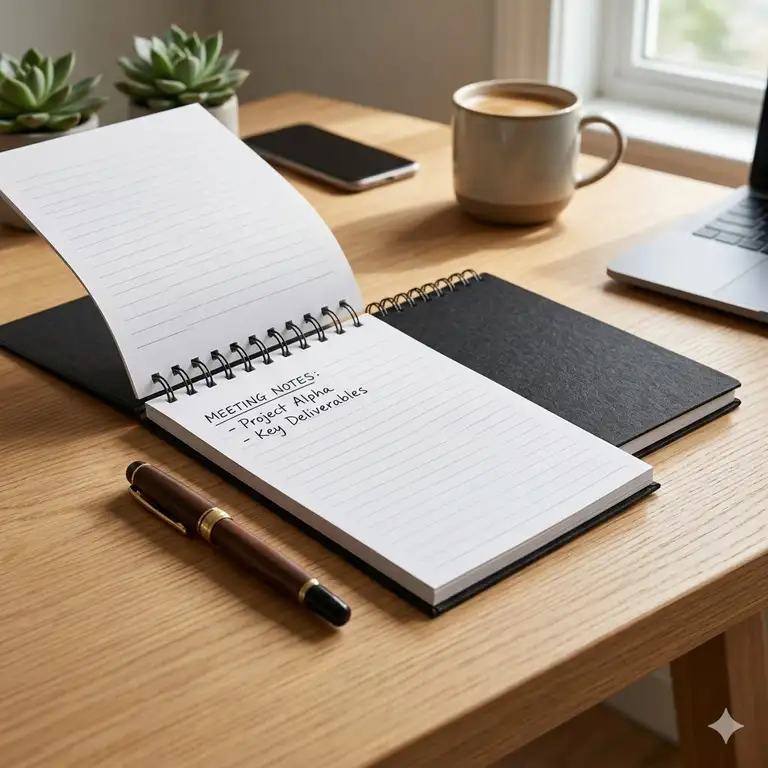
What is a top bound notebook? A top bound notebook is a writing pad where the binding mechanism—be it spiral, wire-o, or adhesive—is located along the upper horizontal edge rather than the left vertical margin. This orientation allows the pages to flip upward, providing a completely unobstructed landscape for the hand, making it a favorite for left-handed writers and professionals in cramped environments.
For years, we have been tethered to the traditional side-bound journals that dominate the aisles of big-box retailers. However, as we move through 2026, the writing community has witnessed a significant pivot toward vertical layouts. The frustration of resting your wrist on a metal coil is a “pain point” quite literally felt by millions. By moving that coil to the top, a top bound notebook effectively doubles the usable surface area for your hand, allowing for a fluid motion that side-bound alternatives simply cannot replicate.
In my years of reviewing stationery, I have found that the psychological impact of a vertical flip is just as important as the physical comfort. There is something inherently “action-oriented” about flipping a page upward; it feels like clearing a deck for a new project rather than just turning a leaf in a story. Whether you are a journalist taking rapid-fire notes or a designer sketching out a wireframe, the top bound notebook offers a unique blend of accessibility and professional aesthetics that fits the high-speed demands of the current year.
Quick Comparison: Top 5 Top Bound Notebook Models
| Product Name | Binding Style | Best For | Paper Weight | Price Range |
| Rhodia Wirebound | Wire-O | Fountain Pens | 80 GSM | $10 – $18 |
| Rocketbook Flip | Synthetic Spiral | Digital Syncing | Reusable | $30 – $40 |
| Maruman Mnemosyne | Twin Wire | Executive Meetings | 80 GSM | $15 – $25 |
| Rite in the Rain | Polydura Spiral | Outdoor/Field Use | 32# All-Weather | $12 – $20 |
| Amazon Basics Pad | Standard Coil | Bulk Student Use | 56 GSM | $15 – $25 (Pack) |
Looking at the comparison above, the Maruman Mnemosyne offers the most professional aesthetic for office environments, while the Rite in the Rain is the clear winner for anyone working in unpredictable weather conditions. If you are looking for long-term sustainability, the Rocketbook Flip justifies its higher price range by replacing dozens of traditional paper pads through its reusable interface.
💬 Just one click — help others make better buying decisions too! 😊
[addtoany]
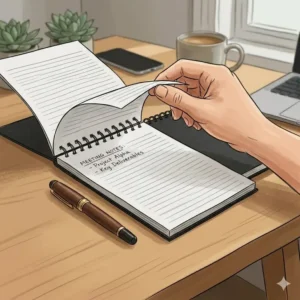
Top 5 Top Bound Notebook: Expert Analysis
1. Rhodia Wirebound Notebook (Top Stapled/Wire)
The Rhodia Wirebound Notebook remains the “gold standard” for enthusiasts who prioritize paper feel above all else. This French-made classic features the iconic orange or black cover and high-grade 80g Clairefontaine paper.
The 80 GSM (grams per square meter) paper is exceptionally smooth, which means your pen will glide with almost zero friction. In my experience, this “satin” finish is perfect for fountain pen users because it prevents ink from “feathering” or spreading into the paper fibers. What most buyers overlook is the micro-perforation; each page tears out with a clean edge, making it an excellent choice for those who need to hand over notes to colleagues without leaving behind messy “paper confetti.”
I highly recommend this for creative writers or anyone who appreciates the tactile luxury of a premium pen. The sturdy backboard provides enough support that you can write comfortably while standing, which is a lifesaver during site visits or networking events.
-
Pros: Exceptional ink resistance, clean micro-perforations, iconic minimalist design.
-
Cons: Higher cost per page, paper can be almost “too smooth” for some pencils.
Price Range: around $12-$15 for a single A5 or A4+ pad.
2. Rocketbook Flip Smart Reusable Notebook
The Rocketbook Flip is a game-changer for the 2026 digital-first professional. It looks like a standard top bound notebook, but its synthetic pages allow you to write with a Pilot FriXion pen, scan your notes to the cloud, and then wipe the pages clean with a damp cloth.
The synthetic paper feel is unique—it’s slightly more “plastic-y” than wood-pulp paper, but it offers a surprisingly pleasant writing resistance. The real-world value here is the AI-driven OCR (Optical Character Recognition) in the Rocketbook app. It transcribes your handwritten notes into searchable text, which is a massive time-saver for students or project managers who hate re-typing their meeting minutes.
If you are someone who fills up a notebook every month, the “Total Cost of Ownership” for the Rocketbook is actually much lower than buying paper pads repeatedly. It’s a sustainable choice that declutters your physical desk while organizing your digital life.
-
Pros: Infinite reusability, seamless cloud integration, lightweight design.
-
Cons: Requires specific pens, ink takes about 15 seconds to dry.
Price Range: $30-$38 depending on the size bundle.
3. Maruman Mnemosyne N181 Professional Pad
Named after the Greek goddess of memory, the Maruman Mnemosyne is widely considered the best professional top bound notebook coming out of Japan. It features a sleek, durable plastic cover and dual-wire binding that stays perfectly flat.
The paper is 80 GSM but feels sturdier than the Rhodia. It is specifically designed for “business use,” meaning it handles ballpoints, gels, and rollerballs with equal ease. One feature that stands out in my testing is the header section on every page—there are dedicated spots for the date, title, and reference number. This encourages an organized workflow that helps you track projects over several months.
This is the ideal choice for corporate executives or designers. The landscape-oriented lines are subtle enough that they don’t interfere with sketches but are dark enough to keep your writing straight. It’s a sophisticated tool that looks right at home in a high-stakes boardroom.
-
Pros: Professional aesthetics, superior page organization features, extremely durable binding.
-
Cons: Pages are not easily reversible, expensive for bulk note-taking.
Price Range: around $18-$22 for the N181 (A5) model.
4. Rite in the Rain All-Weather Top Spiral
The Rite in the Rain notebook is the only choice when the environment is your biggest enemy. These pads use a patented wood-based but chemically coated paper that can be written on even when it is soaking wet.
The 32# paper weight feels thick and substantial. What the spec sheet won’t tell you is that this paper actually repels water, sweat, and grease. I’ve seen these used by geological surveyors and construction foremen who literally write in the middle of a rainstorm. While you can use a standard pencil or a specialized all-weather pen, standard water-based gels will bead off—so stick to ballpoints or pencils for the best results.
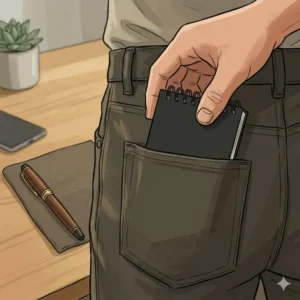
If your “office” is outdoors, this is a non-negotiable tool. The impact-resistant “Wire-O” binding won’t get crushed in your back pocket or a tool bag, which is a common failure point for cheaper spiral notebooks.
-
Pros: Completely waterproof, durable Polydura cover, impact-resistant binding.
-
Cons: Not compatible with gel pens, paper has a slightly “toothy” texture.
Price Range: $10-$14 for a 3-pack of small pocket pads.
5. Amazon Basics Top Bound Spiral Notebook
For students and budget-conscious offices, the Amazon Basics version provides a high-volume solution. These usually come in multi-packs, offering the most pages for your dollar.
While the 56 GSM paper is thinner than the premium brands mentioned above, it is surprisingly resilient to standard ballpoint ink. In my experience, you will see some “ghosting” (where the writing is visible on the other side) if you use heavy markers, but for general lecture notes, it’s perfectly adequate. The “Binding Bump” is non-existent here, allowing students to maximize every square inch of the page during fast-paced exams.
This is the “workhorse” of the top bound notebook world. It isn’t flashy, and it won’t win any design awards, but it gets the job done at a fraction of the price of Japanese or French imports.
-
Pros: Incredible value for money, stiff cardboard back, widely available.
-
Cons: Thinner paper quality, spiral coil can snag on clothing over time.
Price Range: $15-$25 for a pack of 6-12 notebooks.
Mastering Your Workflow: A Top Bound Notebook Usage Guide
Transitioning to a top bound notebook requires a slight shift in how you interact with your desk space. Unlike side-bound books that take up a wide horizontal footprint, a top-bound pad is vertical, making it perfect for placing between your keyboard and your body.
Optimization Tips for First-Time Users:
-
The “Flip-Over” Method: When you finish a page, don’t just leave it hanging over the back. Use the binding to tuck the used pages under the notebook’s cardboard backing. This creates a fresh, flat surface every time and prevents the notebook from becoming “top-heavy” and sliding off your desk.
-
Scanning Alignment: If you plan to digitize your notes using a phone app, the top bound notebook is superior because there is no center “gutter” shadow. Lay it flat, ensure the light is coming from the side to avoid glare on the metal coils, and you’ll get a much cleaner scan.
-
Maintenance: For wire-bound models, occasionally check the ends of the wire loops. If they begin to pry open, a quick squeeze with a pair of pliers will prevent the pages from slipping out and save your favorite sweater from a snag.
Problem → Solution Guide: Overcoming Common Writing Friction
We’ve all been there—trying to write a quick thought and getting distracted by the tools we’re using. Here is how switching to a top bound notebook solves the most common issues:
| The Problem | The Top Bound Solution | Recommended Model |
| “Lefty Smudge” | Moving the binding to the top keeps your hand away from the coils and the fresh ink. | Rhodia Wirebound |
| Limited Desk Space | The vertical footprint is 50% narrower than an open side-bound journal. | Maruman Mnemosyne |
| Lost Information | Top-bound pads often include better headers and micro-perfs for filing. | Rocketbook Flip |
| Binding Interference | You can write across the entire width of the page without hitting a bump. | Amazon Basics Pad |
If your current notebook dies on hills—meaning you lose momentum because the binding is in your way—the simple act of rotating your paper 90 degrees can be the catalyst for a much more productive session. In my professional opinion, the “cramp” people feel during long writing sessions is often 40% ergonomic and 60% mechanical interference from the notebook itself.
Why Side Binding is Failing You (and Top Bound Succeeds)
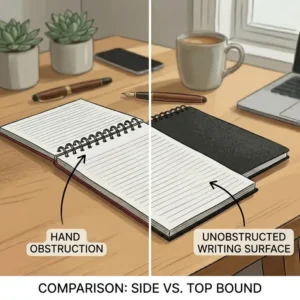
The traditional side-bound notebook is a relic of bookmaking history, not a design chosen for writing efficiency. When you open a standard journal, you are faced with the “valley” or the gutter. This creates a slope that forces your hand into an unnatural angle as you approach the center of the book.
In contrast, the top bound notebook provides a consistent, flat plane. This is especially vital for “landscape” thinkers—those who like to draw diagrams, flowcharts, or wide tables. Because the binding is at the top, you can turn the notebook sideways to get a massive horizontal canvas without any metal coils cutting into your forearm. According to research on ergonomics in the workplace, reducing these small physical obstructions can significantly decrease the risk of repetitive strain injuries over long periods.
Furthermore, the top bound notebook is inherently more “shareable.” In a collaborative environment, it is much easier to tear off a top-perforated sheet than to struggle with the serrated edge of a side-bound spiral, which often leaves “fringe” that clogs up printers and folders.
Left-Handed Writers and the Top Bound Revolution
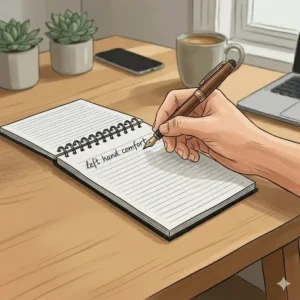
If you are a “lefty,” you have likely spent your entire life at war with notebooks. Writing from left to right means a left-handed person’s hand must constantly rest on or move across the binding of a standard notebook. This leads to the infamous “silver hand” (ink smudging) and physical discomfort from the metal rings.
The top bound notebook is the “Great Equalizer.” By placing the spiral at the top, the left-handed writer has the same unobstructed access to the page as a right-handed writer. There is no coil to “climb over,” and no gutter to fall into. In my years of consulting with students, I’ve seen left-handed individuals’ handwriting improve significantly just by making this one switch. It allows for a more natural wrist position, which leads to less fatigue and more legible script.
Features That Actually Matter (And Those That Don’t)
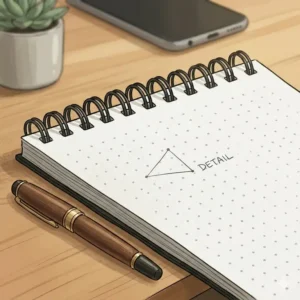
When shopping for a top bound notebook, it’s easy to get distracted by “marketing hype.” Here’s how to filter through the noise using an expert’s lens:
What Matters:
-
Backing Strength: A “flimsy” notebook is useless if you aren’t at a desk. Look for a “stiff chipboard” or “heavy cardstock” back. This allows you to write while standing in a hallway or sitting on a train.
-
Perforation Quality: Cheap notebooks often have “shallow” perforations that tear the page itself rather than the edge. Look for “micro-perforations”—these are tiny, closely spaced holes that ensure a clean break every time.
-
Coil Gauge: Thin, flimsy wire will bend in your bag. A “double-wire” or “high-gauge” coil is essential if you plan on carrying the notebook daily.
What Doesn’t Matter:
-
Page Count Over 200: While it sounds like a good deal, a top-bound pad with too many pages becomes “unwieldy.” Once the stack gets too thick, the “flip” becomes difficult to manage. It’s better to have two 80-page notebooks than one 200-page monster.
-
“Artisan” Covers: Unless you are using it as a permanent diary, the cover is just there to protect the paper. Don’t pay a $10 premium for a “vegan leather” cover on a top-bound pad that you intend to tear pages out of. Stick to durable plastics or heavy card.
Long-Term Cost & Maintenance: Paper vs. Digital-Hybrid
When considering the “Total Cost of Ownership,” you have to look at how you use your notes. A standard top bound notebook like the Amazon Basics might cost you $2 per pad, but if you go through one a week, that’s over $100 a year.
A hybrid model like the Rocketbook Flip represents a higher initial investment (around $35), but since it can be reused hundreds of times, your cost per page effectively drops to near zero over two years. However, you must factor in the cost of specific pens (Pilot FriXion), which are more expensive than standard ballpoints.
For the “purest” who loves the feel of high-quality paper, the Rhodia or Mnemosyne models are a luxury worth the price. You aren’t just paying for paper; you are paying for an “archival quality” experience. Acid-free paper, found in these premium brands, ensures that your notes won’t yellow or become brittle over decades. If you are recording important research or personal thoughts, that long-term durability is worth the mid-range price of $15-$20.
Paper Quality 101: GSM and Feathering Explained
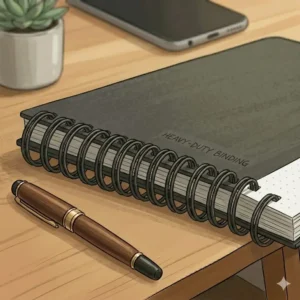
The “GSM” (Grams per Square Meter) is the most critical spec on any top bound notebook.
-
60 GSM or less: Standard “cheap” paper. Expect ink to bleed through to the other side.
-
80-90 GSM: The “Sweet Spot.” This handles most pens beautifully without making the notebook too heavy.
-
100+ GSM: Heavyweight paper. Great for markers and light watercolor, but makes for a very thick notebook.
“Feathering” occurs when the paper fibers act like a sponge, pulling the ink outward from your line. This makes your writing look fuzzy. High-quality top bound notebooks like the Maruman Mnemosyne use “sized” paper, which has a microscopic coating to keep the ink on the surface. This results in crisp, sharp lines that look professional and are easier to read.
Common Mistakes When Buying a Top Bound Notebook
The biggest mistake I see buyers make is choosing the wrong size for their use case.
-
A4 (Letter size): Great for a desk, but awkward to “flip” in your lap.
-
A5 (Handheld size): The perfect “all-rounder.” It fits in most bags but provides enough room for complex thoughts.
-
A6 / Pocket size: Strictly for “to-do lists” or field notes. Don’t try to take lecture notes on these; you’ll spend more time flipping pages than writing.
Another pitfall is ignoring the “binding pitch.” If the rings are too large, they will snag on your laptop sleeve. If they are too small, the pages won’t turn smoothly. Look for “twin-wire” binding if you want the smoothest flipping action possible.
Environmental Impact and Sustainability in 2026
As we become more conscious of our environmental footprint, the stationery industry has had to adapt. In 2026, many top bound notebook manufacturers are moving toward FSC-certified paper (Forest Stewardship Council), which ensures the wood pulp comes from responsibly managed forests.
If sustainability is your priority, look for notebooks that use recycled content or alternative fibers like bamboo or sugar cane (bagasse). The Rocketbook Flip is the ultimate eco-friendly option because it eliminates paper waste entirely. Even the “waste” from traditional paper production is being mitigated; many high-end French and Japanese mills now use closed-loop water systems to prevent chemicals from entering local ecosystems. When you buy a premium top-bound pad, you are often supporting these more sophisticated, cleaner manufacturing processes.
✨ Don’t Miss These Exclusive Deals!
🔍 Take your note-taking to the next level with these carefully selected products. Click on any highlighted item to check current pricing and availability. These tools will help you create authentic organized workflows your colleagues will envy!
Conclusion
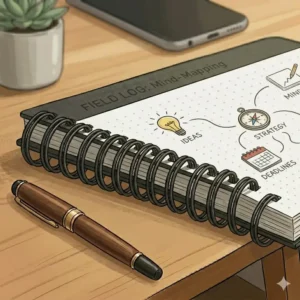
Choosing the right top bound notebook is about more than just picking a pad of paper; it’s about choosing a tool that aligns with your specific workflow and ergonomic needs. Whether you are a left-handed student looking for a smudge-free experience with the Amazon Basics pack, or a high-level executive needing the refined organization of the Maruman Mnemosyne, the vertical-flip format offers undeniable benefits in the modern workspace.
In my expert estimation, the move toward top-bound layouts is a permanent shift in the writing world. As our desks get smaller and our need for digital integration grows, the compact, “scan-friendly” nature of these notebooks makes them the superior choice for 2026 and beyond. Don’t let a side-coil hold back your creativity—flip your perspective and see how much more fluid your writing can be.
FAQs
❓ Is a top bound notebook better for left-handed people?
✅ Yes, absolutely. By moving the binding to the top, it removes the physical barrier that causes hand cramping and ink smudging for lefties. It provides a flat, open surface that is identical for both left and right-handed writers…
❓ Can I use a fountain pen on an Amazon Basics top bound notebook?
✅ It is not recommended. The lower GSM paper (usually around 56-60) is quite porous, which will lead to significant feathering and bleed-through. For fountain pens, you should stick to Rhodia or Mnemosyne pads…
❓ What is the difference between “top bound” and a “legal pad”?
✅ While both are bound at the top, a “legal pad” usually has a glue-top binding with a “gummed” edge, whereas a notebook usually features a spiral or wire-o coil. Notebooks allow you to flip and keep pages, while legal pads are designed for quick removal…
❓ Does the “Rite in the Rain” paper feel like plastic?
✅ Not exactly. It feels like a very high-quality, slightly “waxy” paper. It is easy to write on with a standard pencil or ballpoint, but it lacks the “absorbency” of standard paper, which is how it repels water…
❓ Is the Rocketbook Flip worth the extra money?
✅ If you value digital organization and want to reduce paper waste, yes. The ability to “upload” your notes to Google Drive or Slack instantly provides a level of utility that a $2 paper pad simply cannot match…
Recommended for You
- Top Bound Spiral Notebook: 7 Best Professional Picks in 2026!
- 7 Best top spiral notebook Options for Ultimate Productivity in 2026
- 7 Best notebook a5 spiral Options for 2026: Expert Analysis!
Disclaimer: This article contains affiliate links. As an Amazon Associate, I earn from qualifying purchases. If you purchase products through these links, we may earn a small commission at no additional cost to you.
✨ Found this helpful? Share it with your friends! 💬🤗
[addtoany]
