

A notebook holder is a specialized ergonomic accessory designed to elevate a laptop or paper notebook to eye level, reducing strain on the neck, back, and shoulders. By positioning the screen or writing surface at an optimal height, these tools help prevent “tech-neck” and promote a more neutral spinal alignment during long work sessions. In the modern 2026 workspace, where hybrid roles are the norm, a notebook holder has transitioned from a luxury to a fundamental necessity for anyone spending more than two hours a day at a desk.
Beyond simple elevation, these devices often incorporate features like heat dissipation for hardware, 360-degree rotation for collaborative sharing, and foldable designs for digital nomads. Whether you are using a high-end gaming laptop or a classic Moleskine, the right support structure transforms a cramped desk into a professional workstation. According to OSHA’s computer workstation guidelines, maintaining a proper line of sight to your work is critical for long-term musculoskeletal health.
Quick Comparison of Top Notebook Holder Solutions
| Product Model | Primary Material | Best Use Case | Adjustability | Price Range |
| Twelve South Curve Flex | Premium Aluminum | Professional Office | High (Height & Tilt) | $75 – $85 |
| Nulaxy C3 Stand | Sandblasted Aluminum | Budget-Conscious | Low (Fixed) | $20 – $30 |
| Rain Design mStand360 | Single Piece Aluminum | Collaborative Work | Medium (Swivel) | $50 – $60 |
| Besign LS03 | Heavy Duty Alloy | Desktop Replacement | High (Multi-angle) | $25 – $35 |
| HumanCentric Vertical | Anodized Aluminum | Clamshell Mode | N/A (Vertical) | $35 – $45 |
Based on the data above, users seeking maximum portability should lean toward the Twelve South Curve Flex, as its collapsible design justifies the higher price point for frequent travelers. Conversely, if your laptop stays anchored to a desk, the Nulaxy C3 Stand offers the best structural stability for under $30. For those who frequently share their screen with colleagues, the Rain Design mStand360‘s swivel base is a superior functional investment over fixed models.
💬 Just one click — help others make better buying decisions too! 😊
[addtoany]

Top 5 Notebook Holder Options: Expert Analysis
1. Twelve South Curve Flex – The Portable Powerhouse
The Twelve South Curve Flex represents the pinnacle of mobile ergonomic design, featuring a dual-hinge system that allows for both height and angle adjustments. It is constructed from premium aluminum that mirrors the aesthetic of modern high-end laptops, making it a favorite for Apple enthusiasts.
The dual-hinge mechanism allows you to raise your screen up to 22 inches while simultaneously tilting the keyboard to a comfortable angle. In my experience, this is the only stand that truly bridges the gap between a permanent desk fixture and a travel accessory. While most “portable” stands feel flimsy, the Curve Flex maintains its tension even with heavier 16-inch workstations. This means you won’t experience the “screen bounce” that plagues cheaper, plastic alternatives during heavy typing.
Expertly suited for the executive who bounces between a home office and corporate headquarters, this notebook holder justifies its “around $80” price tag through sheer durability. Customer feedback consistently highlights the included neoprene travel sleeve, which prevents the metal edges from scratching other gear in a laptop bag.
-
Pros: Highly adjustable height (up to 22″), extremely portable, includes travel case.
-
Cons: Higher price point, hinges may require tightening after extensive use.
-
Price Range: $75 – $85 (Check current price at research)
2. Nulaxy C3 Laptop Stand – The Sturdy Essential
The Nulaxy C3 Laptop Stand is a fixed-height notebook holder that prioritizes stability and airflow above all else. It is composed of three detachable aluminum parts that snap together to create a rock-solid platform for laptops ranging from 10 to 15.8 inches.
Featuring a 6-inch elevation, this stand is designed to bring your screen to a standard ergonomic height without the complexity of moving parts. What most buyers overlook is the open-air design; by leaving the underside of the notebook exposed, it acts as a passive heat sink. In practical terms, this can reduce internal fan noise during intensive tasks like video rendering or large-scale data processing.
I recommend this for students or home-office beginners who use an external keyboard and mouse. Because it isn’t adjustable, it forces you into a specific, healthy posture that prevents slouching. At “around $25,” it is the gold standard for budget-friendly ergonomics. Users often mention that the rubber pads are surprisingly grippy, ensuring the laptop doesn’t slide even when bumped.
-
Pros: Very affordable, excellent heat dissipation, simple assembly.
-
Cons: No height adjustment, requires external keyboard for comfort.
-
Price Range: $20 – $30 (Prices may vary)

3. Rain Design mStand360 – The Collaborative Choice
The Rain Design mStand360 takes the classic “single-piece” aluminum design and adds a hidden swivel base, allowing for a full 360-degree rotation with the flick of a finger. This notebook holder is sandblasted and anodized to match the finish of premium hardware perfectly.
The swivel feature isn’t just a gimmick; it is a vital tool for professionals who work in client-facing environments or collaborative pods. The base rotates smoothly without stuttering, which is essential when you need to show a design mockup to a coworker sitting across from you. Furthermore, the teardrop-shaped cable outlet in the back keeps your workspace tidy, managing the “spaghetti” of USB-C and power cables that usually clutter a desk.
In my professional opinion, this is the best choice for designers and architects who value a clean aesthetic and functional fluidity. The solid aluminum body also acts as a massive heat sink, drawing warmth away from the laptop’s battery. Customer reviews frequently praise the “buttery smooth” rotation mechanism which remains silent even after years of use.
-
Pros: 360-degree swivel base, acts as a heat sink, elegant cable management.
-
Cons: Large footprint on desk, not portable.
-
Price Range: $50 – $60 (At the time of research)
4. Besign LS03 – The Heavy-Duty Versatile Stand
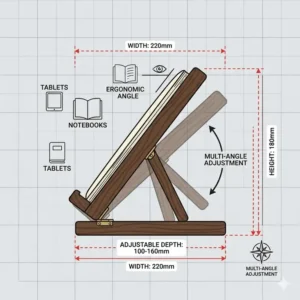
The Besign LS03 is an adjustable notebook holder that focuses on vertical range, offering multiple height settings to accommodate users of different statures. It is built from a thickened aluminum alloy, supporting up to 13 lbs of hardware.
The spec sheet says it adjusts from 5 to 7.5 inches, but what that means in practice is that a 6’2″ user can finally stop looking down at their screen. Cheaper stands often top out at 5 inches, which still leaves taller individuals in a sub-optimal postural position. The Besign LS03 solves this by providing that extra bit of verticality that makes a massive difference in neck strain over an 8-hour workday.
This product is the “workhorse” of the group. If you own a heavy 17-inch gaming laptop or a rugged workstation, this is the stand you want. It doesn’t wobble, and the front tabs are deep enough to catch even the thickest chassis. Buyers appreciate that it feels “industrial strength” compared to the sleek but delicate options from competitors.
-
Pros: High weight capacity, multiple height tiers, deep safety tabs.
-
Cons: Adjustment requires some force, slightly bulky.
-
Price Range: $25 – $35 (Around $30 typically)
5. HumanCentric Vertical Laptop Stand – The Space Optimizer
The HumanCentric Vertical Laptop Stand is a different breed of notebook holder designed for “clamshell mode.” It holds the laptop vertically, freeing up nearly 90% of the desk space typically occupied by the device.
If you primarily use your notebook with a large external monitor, this stand is a revelation. It features an adjustable width via an underside knob, meaning it can snugly fit anything from a thin tablet to a thick gaming rig. By moving the laptop to a vertical position, you improve the airflow to the intake vents (which are usually on the bottom), potentially extending the life of your internal components.
From an expert perspective, this is the ultimate solution for the “minimalist” desk setup. It turns your laptop into a sleek desktop tower. Just be aware that you cannot use the laptop screen while it is in this holder. Most customers love the weighted base, which ensures that even a top-heavy laptop won’t tip over if the desk is jostled.
-
Pros: Massive space savings, adjustable width, premium weighted feel.
-
Cons: Cannot use the laptop screen, requires external peripherals.
-
Price Range: $35 – $45 (Prices subject to change)
✨ Don’t Miss These Exclusive Deals!
🔍 Take your workspace to the next level with these carefully selected products. Click on any highlighted item to check current pricing and availability. These tools will help you create an authentic, productive environment that your body will love!

How to Choose the Right Notebook Holder
Selecting a notebook holder requires more than just picking the prettiest aluminum slab. You need to align the hardware features with your specific physiological needs and desk environment.
-
Assess Your Height Requirements: If you are taller than 6 feet, look for stands that offer at least 7 inches of elevation. A standard 6-inch stand may still result in a downward gaze, defeating the purpose of an ergonomic upgrade.
-
Determine Your Portability Needs: Do you work from a fixed desk, or are you a “coffee shop hopper”? Foldable, Z-shaped stands like the Twelve South Curve Flex are essential for the latter, while a solid one-piece stand like the Rain Design mStand360 is better for a permanent home setup.
-
Check Weight Capacity: Modern ultrabooks are light, but creative workstations can exceed 6 lbs. Always verify that the stand’s tension or structural integrity can support your specific model without sagging.
-
Evaluate Material Quality: Aluminum is the gold standard because it doubles as a thermal conductor. Avoid plastic stands for high-performance laptops, as they can trap heat and lead to thermal throttling.
-
Consider Desktop Footprint: If you have a small “cluttered” desk, a vertical stand or a stand with a small base (like the Besign LS03) is preferable over wide-base models that eat up valuable real estate.
Transformation: Problem → Solution Guide
Many buyers purchase a notebook holder hoping for a “magic fix” to their back pain, only to find they are using it incorrectly. Here is how to solve the most common issues:
-
Problem: The “Wobble” While Typing
-
Solution: If you use an adjustable stand and notice it shaking when you type, the solution is simple: Stop typing on the laptop keyboard. A notebook holder is designed to be used with an external keyboard and mouse. Elevation naturally makes the laptop keyboard unstable and ergonomically taxing for the wrists.
-
-
Problem: Neck Pain Persists After Setup
-
Solution: Your eyes should be level with the top third of your screen. If you’ve added a stand but are still looking down, you likely need a “stackable” solution or a stand with a higher vertical reach like the Besign LS03. Use a ruler to measure your eye level from the desk and match the stand height accordingly.
-
-
Problem: Laptop Overheating on the Stand
-
Solution: Ensure you aren’t using a stand with a solid backplate. Look for “X-frame” or “H-frame” designs that leave the center of the laptop bottom exposed. This allows the internal fans to pull in cool air more efficiently.
-

What to Expect: Real-World Performance
When you first integrate a notebook holder into your routine, the transition can feel “awkward” for about 48 hours. This is because your muscles are used to a hunched, forward-leaning position—a phenomenon often called “Upper Crossed Syndrome.” As you sit more upright, you might feel a slight tension in your upper back as those dormant muscles begin to engage.
Within a week, however, the “real-world” benefits manifest as a reduction in end-of-day headaches and shoulder stiffness. You’ll also notice that your desk feels larger. By lifting the laptop, you create a “garage” underneath the stand where you can tuck away your keyboard, external hard drives, or even a notepad when not in use.
Furthermore, the “professionalism factor” is a hidden perk. During Zoom or Teams calls, a notebook holder raises your camera to eye level. This eliminates the dreaded “looking up your nose” angle common with laptops sitting flat on a desk, making you look more engaged and professional to clients and colleagues alike.
Common Mistakes When Buying a Notebook Holder
The most frequent error I see is buyers choosing a stand based solely on aesthetics without checking the front lip depth. If you have an older, thicker laptop (like a gaming rig or a rugged business laptop), many “sleek” stands have a lip that is too shallow to hold the device securely. In my experience, there is nothing more heart-dropping than watching a $2,000 laptop slide off a $30 stand because the safety tabs were only designed for a MacBook Air.
Another pitfall is ignoring cable routing. A stand that doesn’t have a hole or a clip for cables will result in your power cords and HDMI leads pulling the laptop to one side. This not only looks messy but can put unnecessary strain on your laptop’s ports. Always prioritize stands with integrated cable management if you use more than one peripheral.
Finally, don’t overlook rubber padding. A quality notebook holder should have silicone or rubber pads on both the top (where the laptop sits) and the bottom (where the stand touches the desk). Without these, the metal-on-metal contact will eventually scratch your expensive laptop’s finish, and the stand will slide around your desk like a hockey puck.
Notebook Holder vs. Lap Desk: Which is Better?
While they sound similar, these two products serve entirely different lifestyles. A lap desk is designed for the “comfort seeker” who wants to work from a couch or bed. It provides a flat, heat-shielded surface for your legs but does nothing to improve your neck posture, as you are still looking down at your lap.
A notebook holder, by contrast, is a posture-correction tool. It is designed for a stationary desk environment. If your goal is to work for 8 hours without needing an Ibuprofen by 5:00 PM, the stand is the winner. If you just want to check emails while watching Netflix, the lap desk is your friend.
In terms of ROI (Return on Investment), a notebook holder generally lasts longer. Since it is made of solid metal rather than plastic and fabric, it won’t wear out or absorb “living room smells” over time. For the serious professional, the stand is a piece of equipment; the lap desk is an accessory.

Features That Actually Matter (And Those That Don’t)
Marketing teams love to talk about “aerospace-grade aluminum,” but in reality, almost all mid-range stands use 6000-series aluminum alloy, which is more than enough for a 5-lb laptop. Here is what actually impacts your daily use:
-
Matters: Silicone Grip Surface. This prevents the laptop from vibrating or shifting.
-
Matters: Height Range. 5 inches is the “minimum” for ergonomics; anything less is just a tilt-wedge.
-
Doesn’t Matter: Built-in Fans. Most built-in fans in stands are small, loud, and inefficient. A stand that simply provides “open airflow” is usually just as effective and much quieter.
-
Matters: Weight of the Base. A heavy base means the stand won’t move when you accidentally bump the desk.
-
Doesn’t Matter: Included RGB Lights. Unless you are a dedicated streamer, lights on a stand are a distraction and an extra cable you don’t need to manage.
Practical Usage Guide: Setup & Maintenance
To get the most out of your new notebook holder, follow these setup steps:
-
The Height Test: Sit in your chair with your back straight. Close your eyes, then open them. Your eyes should land directly on the top edge of the screen. Adjust your stand until this is achieved.
-
Peripheral Integration: Connect an external keyboard and a mouse. If you use a laptop stand without these, you are trading neck pain for wrist pain (Carpal Tunnel).
-
Cable Slack: Leave enough slack in your power cable so that if you rotate or move the stand, it doesn’t yank on the laptop’s charging port.
-
Maintenance: Aluminum stands are magnets for fingerprints and dust. Wipe yours down once a week with a microfiber cloth and a tiny bit of rubbing alcohol to keep it looking premium. If you have an adjustable stand, check the hinge screws every 6 months and tighten them with a hex key if they start to feel “loose.”
✨ Don’t Miss These Exclusive Deals!
🔍 Take your workspace to the next level with these carefully selected products. Click on any highlighted item to check current pricing and availability. These tools will help you create an authentic, productive environment that your body will love!
Conclusion
Investing in a high-quality notebook holder is one of the most cost-effective ways to upgrade your workspace in 2026. Whether you opt for the ultra-portable Twelve South Curve Flex or the budget-friendly Nulaxy C3, the goal remains the same: protecting your long-term health while boosting daily productivity. By elevating your screen, you’re not just moving a piece of plastic and metal; you’re aligning your body for a more comfortable, sustainable way of working. Don’t wait for the neck pain to become chronic—make the switch to an ergonomic setup today.
FAQs
❓ Can I use a notebook holder for a tablet?
✅ Yes, most stands designed for 10-15 inch laptops work perfectly for tablets like the iPad Pro or Surface. Just ensure the front lip doesn’t obstruct the screen’s touch sensors or the bottom navigation bar…
❓ Does a notebook holder help with laptop cooling?
✅ Absolutely. By lifting the device off a flat surface, you prevent heat soak into the desk. Open-frame aluminum stands act as a passive heat sink, allowing internal fans to move air more freely…
❓ Are foldable notebook holders stable enough for heavy typing?
✅ Generally, no. Foldable stands are meant to elevate the screen while you use an external keyboard. If you must type directly on the laptop, a solid, non-adjustable stand like the Nulaxy C3 is far more stable…
❓ What is the best height for a notebook holder?
✅ The ideal height allows the top of your screen to be at or slightly below eye level. For most adults sitting in a standard office chair, this requires an elevation of 5 to 8 inches…
❓ Do I need tools to assemble a notebook holder?
✅ Most premium models like the Rain Design come fully assembled. Budget models may require 2-4 screws, usually with an included Allen wrench, and take less than five minutes to set up…
Recommended for You
- 5 Best travelers notebook cover Picks for 2026: A Masterclass in Analog
- 7 Best Titanium Mechanical Pencil Options for 2026: Expert Review
- Best Pocket Pen: Top 7 Compact & High-Performance Picks for 2025
Disclaimer: This article contains affiliate links. As an Amazon Associate, I earn from qualifying purchases. If you purchase products through these links, we may earn a small commission at no additional cost to you.
✨ Found this helpful? Share it with your friends! 💬🤗
[addtoany]
