
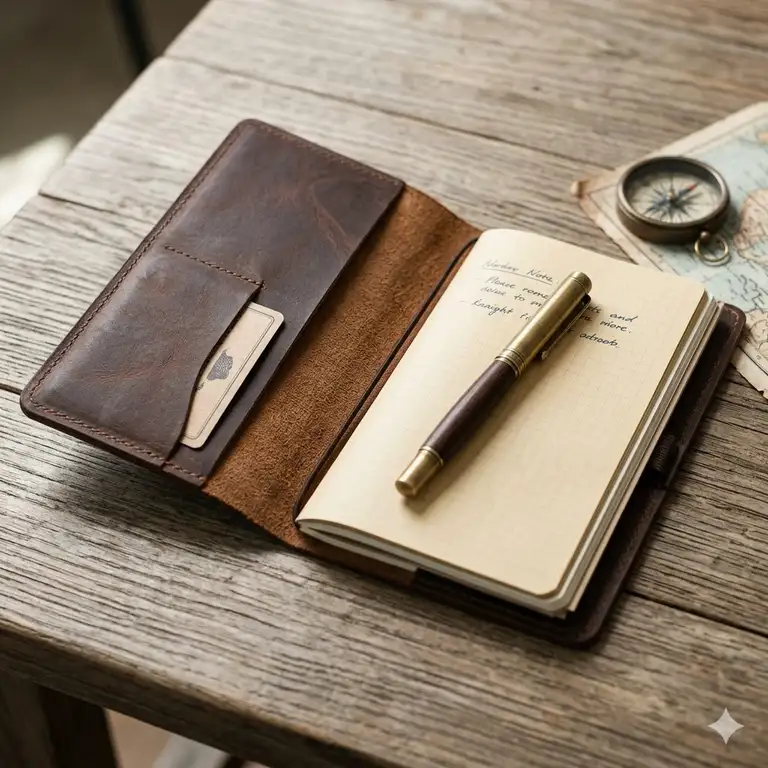
In a world increasingly dominated by digital noise, the travelers notebook cover has become the ultimate sanctuary for the analog soul. But what is it, exactly? At its core, it is a simple yet ingenious leather or fabric wrap designed to hold multiple notebook inserts using a system of elastic bands. Unlike a traditional bound journal, this modular design allows you to swap out paper, planners, and folders, creating a truly customized organizational tool that evolves with your needs.
The concept gained global popularity through the Japanese brand Midori (now Traveler’s Company), but by 2026, the market has expanded into a vibrant ecosystem of artisanal makers and functional innovators. Whether you are a minimalist poet, a frantic corporate strategist, or a world traveler, this cover acts as the “chassis” for your thoughts. According to historical records on the evolution of stationery and journaling, the shift back to physical writing is a documented response to “digital fatigue.” Using a high-quality cover isn’t just about aesthetics; it’s about tactile feedback and the permanence of ink on paper.
In my experience, the best covers are those that don’t just protect your notes but develop a “patina”—a unique wear pattern that tells the story of your travels. Choosing the right one requires looking past the surface grain and understanding the mechanics of the elastic tension, the thickness of the hide, and the compatibility of the inserts. This guide is designed to cut through the marketing fluff and help you find a companion that will last decades, not just a few months of planning.
Quick Comparison: Top travelers notebook cover Options for 2026
| Product Name | Primary Material | Best For | Weight Profile | Price Range |
| TRAVELER’S COMPANY Blue Leather | Japanese Cowhide | Purists & Minimalists | Ultra-Light | around $50 – $65 |
| Wanderings Refillable Journal | Full-Grain Leather | Budget Adventurers | Rugged/Heavy | around $20 – $30 |
| Galen Leather Slim Cover | Crazy Horse Leather | Professional/Office | Slim/Sleek | around $55 – $80 |
| Moterm Luxe Pebbled Cover | Top-Grain Pebbled | Organization Junkies | Modular/Thick | around $45 – $60 |
| September Leather Rustic | Oil-Tanned Leather | Artists/Sketchers | Mid-Weight | around $25 – $35 |
Looking at the data above, the TRAVELER’S COMPANY model remains the gold standard for those prioritizing a lightweight, authentic experience, though its “purist” design lacks the pockets found in modern competitors. If you’re a heavy commuter who needs internal storage for cards and receipts, the Moterm or Galen Leather options offer significantly better ROI by doubling as a wallet. Budget-conscious buyers should lean toward Wanderings, which provides a thicker, more rugged hide that handles abuse better than the more “refined” luxury brands.
💬 Just one click — help others make better buying decisions too!😊
[addtoany]
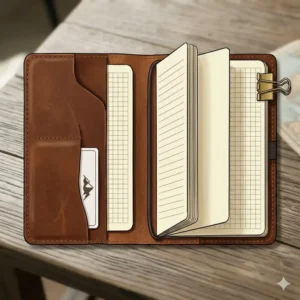
The Top 5 travelers notebook cover Picks: Expert Analysis
1. TRAVELER’S COMPANY Blue Edition — The Original Icon
This is the “original” travelers notebook cover that started the movement. The leather is sourced from Chiang Mai, Thailand, and finished in Japan with a focus on simplicity and durability.
The 2mm thick cowhide is vegetable-tanned, which means it starts stiff but softens beautifully over time. The “Blue Edition” is particularly famous for its deep, midnight hue that reveals hidden highlights as it scuffs. In practical terms, this cover is designed for a 1-to-3 insert setup; any more than that, and you’ll experience “overhang,” where the notebooks peek out from the edges.
What most buyers overlook is the simplicity of the elastic replacement. Unlike complex stitched covers, you can repair this yourself in two minutes with a bit of cord. I recommend this for the traveler who values a slim profile and doesn’t want the bulk of extra pockets or zippers.
✅ Pros:
-
Authentic heritage and high resale value.
-
The most extensive ecosystem of official inserts and accessories.
-
Extremely lightweight and pocket-friendly.
❌ Cons:
-
Lacks internal pockets or pen loops.
-
The leather can be prone to “bleeding” slightly when new.
Price Range: around $50-$65 depending on local availability.
Value Verdict: The gold standard for purists who want a cover that ages with grace and carries history.
2. Wanderings Refillable Leather Journal — The Rugged Workhorse
If you’re prone to tossing your gear into a backpack without a second thought, the Wanderings travelers notebook cover is built for your lifestyle.
Constructed from thick, oil-tanned full-grain leather, this cover smells like a traditional saddle shop. The oil-tanning process makes it highly resistant to water and scratches; in fact, most scuffs can be rubbed out with your thumb. The spec sheet lists this as “rustic,” but in reality, it’s a tank. It’s slightly wider than the original Japanese version, which means it comfortably holds up to 4 inserts without the “alligator mouth” look where the cover won’t stay closed.
In my opinion, this is the best entry-point for beginners. It includes three starter inserts, making it a “complete kit” right out of the box. While it doesn’t have the “prestige” of a Japanese import, the leather quality is arguably more durable for outdoor use.
✅ Pros:
-
Extra-thick leather provides superior protection for paper.
-
Includes starter inserts, offering excellent initial value.
-
Wider spine accommodates more notebooks without bulging.
❌ Cons:
-
Significantly heavier than the TRAVELER’S COMPANY version.
-
The elastic knot is located on the back cover, which can cause a bump when writing.
Price Range: around $20-$30 range.
Value Verdict: Unbeatable price-to-performance ratio for students and outdoor enthusiasts.
3. Galen Leather Slim Notebook Cover — Artisanal Perfection
Hailing from a family-owned workshop in Turkey, the Galen Leather travelers notebook cover represents the pinnacle of craftsmanship in 2026.
This cover uses “Crazy Horse” leather, which is a type of top-grain leather that has been treated with wax. The result is a surface that changes color when folded or scratched, creating a stunning “lived-in” look within days. This model features a slimmed-down profile compared to their older versions, designed specifically to avoid the bulk that often plagues leather journals.
What the marketing won’t tell you is that Galen treats their edges with a burnish that prevents fraying—a common issue with cheaper handmade alternatives. I find this cover perfect for the creative professional who needs their journal to look sharp in a boardroom while still maintaining that “writerly” soul.
✅ Pros:
-
Hand-stitched pen loop and card slots included.
-
Stunning color depth and unique patina development.
-
Reinforced spine prevents “leather sag” over years of use.
❌ Cons:
-
Crazy Horse leather marks very easily (not for those who like a “clean” look).
-
Slightly higher price point than mass-market options.
Price Range: around $55-$80.
Value Verdict: A luxury investment for the serious journaler who appreciates handmade detail.
4. Moterm Luxe Pebbled Travelers Notebook — The Organization King
The Moterm travelers notebook cover is the antithesis of the “simple leather wrap.” It is designed for those who want their journal to replace their wallet.
Featuring high-quality pebbled leather, this cover is soft to the touch right out of the box—no “break-in” period required. The standout feature is the “Luxe” interior, which includes a full-length zipper pocket, multiple card slots, and a large back pocket for receipts or boarding passes. This isn’t just a notebook; it’s a portable office.
The spec sheet says “Top-Grain Pebbled Leather,” but in practice, this feels more like a luxury handbag than a rugged journal. Because it is a “reinforced” cover (two layers of leather stitched together), it stays flat when writing, which is a massive plus for those who struggle with the floppy nature of single-layer covers.
✅ Pros:
-
Replaces the need for a separate wallet or clutch.
-
Lays flatter than almost any other TN cover on the market.
-
The pebbled finish is very resistant to visible scratches.
❌ Cons:
-
The bulkiest option on this list; won’t fit in most back pockets.
-
Can feel “less authentic” to those who prefer a single piece of raw leather.
Price Range: around $45-$60.
Value Verdict: The best choice for the “Everything Journaler” who needs maximum storage.
5. September Leather Travelers Notebook — The Reliable Mid-Range
The September Leather travelers notebook cover hits the sweet spot between “budget” and “luxury,” offering a refined rustic look that doesn’t break the bank.
This cover uses a softer, more pliable oil-tanned leather than the Wanderings model. It feels broken-in from day one. The edges are roughly cut for a “mountain man” aesthetic, but the elastic system is surprisingly sophisticated, featuring a metal clasp that keeps everything centered.
I often recommend this to people who are unsure if they will stick with the travelers notebook system. It’s affordable enough to be an experiment but high-quality enough that you won’t feel the need to upgrade for a long time. The included PVC zipper pouch is a nice touch, as it allows you to store stickers or stamps—something most brands charge extra for.
✅ Pros:
-
Soft, supple feel that conforms to your hand immediately.
-
Includes a PVC storage insert for organization.
-
Balanced weight—not too heavy, not too flimsy.
❌ Cons:
-
The leather can have a strong “factory” smell initially.
-
The interior is unfinished, which can shed small leather fibers onto your paper.
Price Range: around $25-$35.
Value Verdict: The perfect “Goldilocks” option for those who want quality without the premium brand tax.
✨ Don’t Miss These Exclusive Deals!
🔍 Take your journaling to the next level with these carefully selected products. Click on any highlighted item to check current pricing and availability. These tools will help you create authentic records your family will love!
Practical Usage Guide: Mastering the Elastic System
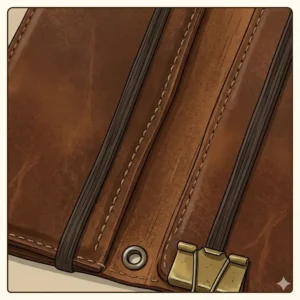
Setting up a travelers notebook cover for the first time can feel like solving a 3D puzzle. Most covers come with one main elastic, but you likely want to carry three or four notebooks. Here is the expert-approved method to maximize your space without ruining the spine.
The “Jump Band” Technique
To hold two notebooks on a single elastic, you need a “jump band”—a small rubber band or extra piece of elastic cord.
-
Open two notebook inserts to their center pages.
-
Slide the jump band around both covers so they are joined back-to-back.
-
Slide the main elastic of your leather cover between the two joined notebooks.
This distributes the tension evenly and prevents the notebooks from sliding out when you open the journal.
Maintenance and “The Sunning” Method
If your leather cover arrives feeling a bit dry or looking dull, don’t immediately reach for heavy oils. In 2026, many enthusiasts are returning to the Leather Working Group’s standards for natural care. A light buffing with a horsehair brush is usually enough. However, if you want to darken the leather naturally, place it in direct sunlight for 2-3 hours. This “tans” the leather, bringing out the natural oils and deepening the color without the need for chemicals.
Avoiding “Insert Overload”
A common mistake is cramming five inserts into a cover designed for three. This causes “flaring,” where the leather won’t close, and the tension on the elastics can eventually tear the paper of your inserts. If you need more than four notebooks, look for “Wide” or “Luxe” versions of covers, which have a broader spine to accommodate the bulk.
Solving the “Bulk Problem”: How to Optimize Your Inserts
One of the most frequent complaints about the travelers notebook cover system is that it becomes too thick to write in comfortably, especially on the left-hand side once you’ve reached the middle of the book. Here is how to solve the “hump” problem.
1. Use a “Shitaji” (Writing Board)
A writing board is a thin, stiff piece of plastic or cardstock that you slide behind the page you are currently writing on. This creates a hard, flat surface, negating the unevenness caused by the elastics or other inserts underneath. It’s a game-changer for anyone with small, precise handwriting.
2. Strategic Insert Placement
Put your “thickest” or most permanent notebook (like a daily planner) in the center of the elastic system. Place thinner, “disposable” notebooks (like scratch pads or grocery lists) on the outside. This creates a natural curve that helps the leather wrap around the contents more securely.
3. The “Wallet” Transition
If you find your cover is getting too heavy, audit your accessories. Many people use a PVC zipper pouch and a leather card holder. In my experience, choosing one or the other is better. If you use a high-quality leather cover like the Moterm, use the built-in pockets and skip the plastic inserts entirely to save about 15% in total thickness.

Choosing the Right Leather: Veg-Tan vs. Oil-Tanned
Not all leather is created equal, and the type of tanning process used on your travelers notebook cover will dictate how it looks in five years. Understanding this is crucial for long-term satisfaction.
Vegetable-Tanned Leather (The Purist’s Choice)
Vegetable tanning is an ancient process using tannins found in tree bark and leaves. It’s environmentally friendly and creates a stiff leather that is highly reactive to its environment.
-
What to expect: It will start light and stiff but will darken and soften with the oils from your hands.
-
Why choose it: You want a cover that looks completely different in 2030 than it does today.
Oil-Tanned Leather (The Adventurer’s Choice)
Oil-tanning involves treating the hide with oils and waxes during the tanning process.
-
What to expect: It is much more supple and “floppy” from the start. It is naturally water-resistant and handles scratches by moving the internal oils around (the “pull-up” effect).
-
Why choose it: You work outdoors, travel frequently, or simply hate the “stiff” feeling of new leather.
Chrome-Tanned Leather (The Fashion Choice)
While less common in high-end TN circles, chrome-tanning is faster and cheaper. It produces vibrant, consistent colors that do not change over time. If you want a bright pink or neon green cover that stays that exact shade forever, chrome-tanned is the way to go. However, it won’t develop a patina, and it often lacks that “real leather” smell.
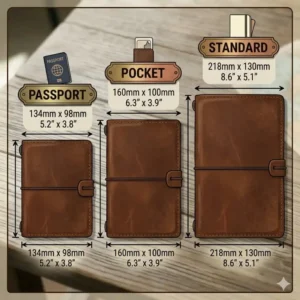
Size Matters: Passport vs. Standard vs. A5
Choosing the wrong size for your travelers notebook cover is the fastest way to ensure it ends up in a desk drawer gathering dust. Let’s break down the three most popular footprints in 2026.
The “Standard” (9.5″ x 4.5″)
This is the classic “slim” profile. It’s designed to hold A5 Slim inserts.
-
Best for: Travel journals and long-form writing. The tall, narrow shape is perfect for boarding passes and maps. It fits well in most bags but is too tall for a pocket.
The “Passport” (5.2″ x 4″)
Exactly what it sounds like—it’s the size of a standard passport.
-
Best for: Wallets, quick capture notes, and people who hate carrying bags. I find the Passport size ideal for “Everyday Carry” (EDC). However, be warned: long-form journaling in this size can be frustrating due to the limited page real estate.
The “A5″ (8.3″ x 5.8”)
A much wider, more traditional notebook size.
-
Best for: Students, artists, and office workers. If you are used to a Moleskine or Leuchtturm120g notebook, the A5 Travelers Notebook will feel most familiar. It provides ample room for sketching, but it is significantly heavier and bulkier than the Standard size.
Features That Actually Matter (And Those That Don’t)
When browsing for a travelers notebook cover, you’ll see a dizzying array of “upgrades.” Here is an expert’s take on what adds value and what is just marketing hype.
Essential: The Pen Loop
Writing without a pen is… difficult. A built-in pen loop (like those on the Galen Leather or Moterm) ensures your favorite fountain pen is always attached. If your cover doesn’t have one, you’ll have to buy a clip-on version, which can scratch the leather over time.
Essential: Burnished Edges
Look at the edges of the leather. Are they raw and fuzzy, or are they smooth and shiny? Burnished (sealed) edges prevent the leather from delaminating or fraying. It’s a mark of quality that indicates the maker took the time to finish the product correctly.
Overrated: Magnetic Closures
Magnets can interfere with hotel key cards and sometimes even modern smartphone screens. Furthermore, a magnetic closure doesn’t “stretch” with your notebook. If you add an extra insert, the magnet might not reach. A classic elastic closure is far superior because it is infinitely adjustable to the thickness of your journal.
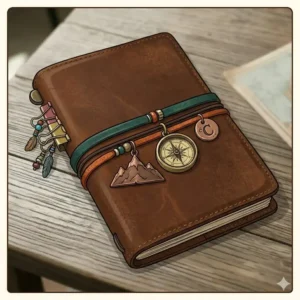
Long-Term Cost & Maintenance of Full-Grain Leather
A high-quality travelers notebook cover is a “buy it once” item, but only if you understand the total cost of ownership. While the cover might cost $50, the inserts are a recurring expense.
The “Paper Trap”
Proprietary inserts (like those from Japanese brands) can cost $6-$10 each. If you fill one a month, that’s $120 a year. To save money, many users in 2026 are turning to “standardized” inserts or making their own using high-quality Tomoe River Paper, which is thin enough to allow for 128 pages in a single slim insert.
Maintenance Costs
You don’t need expensive leather kits. A tin of Smith’s Leather Balm or even a tiny bit of coconut oil (used sparingly!) will keep your cover supple for decades. In my experience, the biggest “cost” is actually the time spent re-threading elastics every 2-3 years, but this is a nominal expense for cordage.
Resale Value
One of the unique things about full-grain leather covers is that they often increase in value if they are from a limited edition or a respected maker. A well-patinaed TRAVELER’S COMPANY cover can often sell for more than its original retail price on the secondhand market, making the “real” cost of ownership very low.
Common Mistakes When Buying a Travelers Notebook Cover
I’ve seen hundreds of people abandon their analog systems within a month. Usually, it’s because of one of these three mistakes.
1. Buying “Genuine Leather”
In the leather world, “Genuine Leather” is actually a specific (and low) grade of leather. It’s made by gluing scraps together and painting the surface. It will peel and crack within a year. Always look for Full-Grain or Top-Grain leather for your travelers notebook cover. These are the top layers of the hide and contain the strongest fibers.
2. Underestimating the “Knot”
In some designs, the elastic knot is located in the middle of the spine. In others, it’s on the back cover. If you plan on writing on the back of pages, a back-cover knot will create a physical bump that makes writing nearly impossible. Check the product photos! The most comfortable covers have the knot tucked into the spine.
3. Ignoring the “Overhang”
If you like using tabs or clips to mark your pages, you need a cover that is slightly wider than the inserts. If the cover is an exact fit, your tabs will stick out and get crushed in your bag. Brands like Wanderings and Moterm tend to be wider, while TRAVELER’S COMPANY is a “tight” fit.

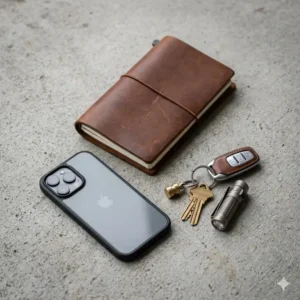
Beyond Journaling: Using Your Cover as a Wallet
By 2026, the trend of “Minimalist Carry” has turned the travelers notebook cover into a hybrid wallet. If you are looking to declutter your pockets, here is how to make the transition.
The Passport Wallet Setup
Using a Passport-sized cover, you can insert one notebook for lists and one PVC card holder. This setup easily holds 6-8 credit cards, cash, and your ID. Because leather is naturally durable, it holds up better than most fabric wallets.
The “Brain Dump” Companion
Professional strategists often use the Standard size as a “Project Wallet.” One insert for meeting notes, one for a calendar, and the internal pockets for business cards. This keeps all “work-related” items in one physical location, allowing you to “close” your work day mentally by literally closing the leather cover.
The Travel Document Organizer
For international travel, a leather cover is indispensable. It holds your passport, boarding passes, SIM card tool, and customs forms in one secure, RFID-shielded (if using a shielded insert) bundle. According to Department of State travel tips, keeping documents organized and protected is the best way to avoid travel-day stress.
Sustainability and Sourcing in 2026
As we move through 2026, consumers are more concerned than ever with where their leather comes from. When choosing a travelers notebook cover, look for brands that prioritize ethical sourcing.
The “LWG” Certification
The Leather Working Group (LWG) is the world’s leading environmental certification for the leather industry. Brands that source from LWG-rated tanneries ensure that their water usage, waste management, and chemical handling meet strict global standards.
Vegan Alternatives
If you prefer not to use animal products, there are now incredible “Cactus Leather” and “Pineapple Leather” (Piñatex) TN covers. These offer a similar tactile experience without the animal hide. However, be aware that these materials typically do not develop a patina and may have a shorter lifespan (5-7 years) compared to the 50-year lifespan of full-grain cowhide.
Supporting Small Makers
By 2026, the “maker economy” is thriving. Choosing a cover from an independent artisan on platforms like Etsy often means you are getting a higher grade of leather than mass-produced items, as small-batch makers hand-select each hide for its character and strength.
✨ Don’t Miss These Exclusive Deals!
🔍 Take your journaling to the next level with these carefully selected products. Click on any highlighted item to check current pricing and availability. These tools will help you create authentic records your family will love!
Conclusion
The journey of finding the perfect travelers notebook cover is, in many ways, the beginning of a better relationship with your own thoughts. Whether you choose the heritage-rich TRAVELER’S COMPANY, the rugged and affordable Wanderings, or the highly organized Moterm, you are investing in a tool that encourages reflection in a fast-paced world.
In my years of exploring analog systems, I’ve found that the “best” cover isn’t the most expensive one—it’s the one that feels right in your hand and makes you want to write. Leather is a living material; it scars, it tans, and it softens, mirroring the experiences you record within its pages. By 2026, these covers have proven they aren’t just a trend; they are a timeless piece of equipment for the modern human.
❓ FAQs
❓ Which travelers notebook cover size is best for beginners?
✅ The “Standard” size is generally best. It offers the most versatile writing space and has the widest availability of inserts, making it easy to find refills at any local stationery shop or online…
❓ Can I use fountain pens with these covers?
✅ Yes, but the cover itself doesn’t matter as much as the paper inside. Look for inserts labeled “Fountain Pen Friendly” or those containing Tomoe River or MD Paper to prevent ink bleeding and ghosting…
❓ How many inserts can a standard leather cover hold?
✅ Most slim covers comfortably hold 3 inserts. With “jump bands,” you can stretch this to 4 or 5, but the cover may not close fully, and the edges of the paper might peek out…
❓ Is “Crazy Horse” leather made from actual horses?
✅ No. It is full-grain cow leather that has been treated with a special wax. The name comes from its original popularity in making horse saddles due to its extreme durability and weather resistance…
❓ How do I stop my travelers notebook cover from smelling?
✅ New leather has a strong natural scent. To reduce it, leave the cover in a well-ventilated room (away from direct heat) for 48 hours. Avoid using perfumes or sprays, as these can damage the leather finish…
Recommended for You
- Journal Brands: The Ultimate Guide to 7 Amazing Notebooks for 2025
- Luxury Notebook Brands: 7 Unbeatable Choices for 2025
- Best Pocket Pen: Top 7 Compact & High-Performance Picks for 2025
Disclaimer: This article contains affiliate links. As an Amazon Associate, I earn from qualifying purchases. If you purchase products through these links, we may earn a small commission at no additional cost to you.
✨ Found this helpful? Share it with your friends! 💬🤗
[addtoany]
