
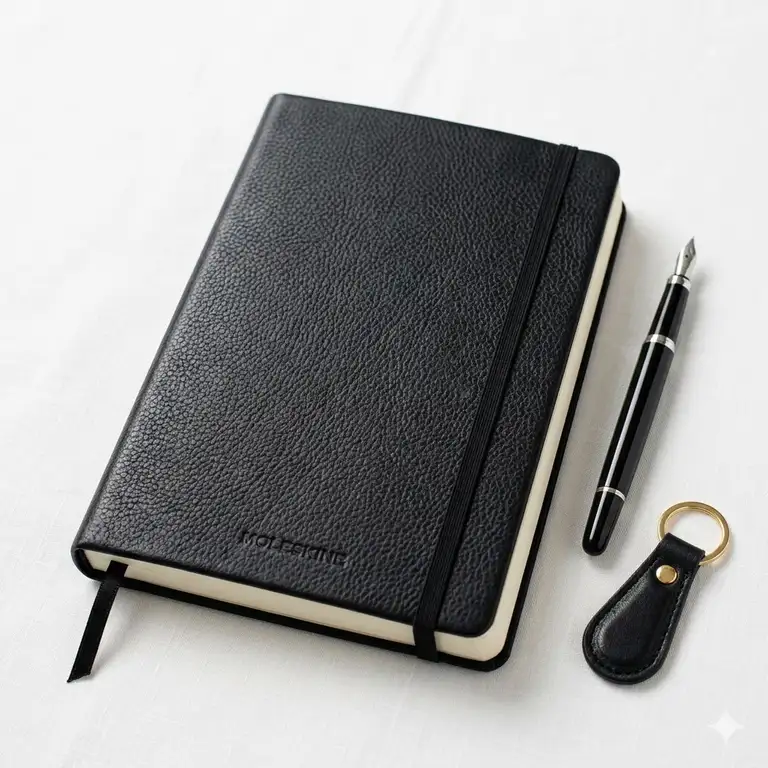
In an era where digital noise is constant, the act of putting pen to paper has become a sacred ritual. Whether you are a traveling architect, a frantic poet, or a corporate strategist, your Moleskine notebook is likely the repository of your most valuable thoughts. However, the standard cardboard-bound Moleskine, while iconic, is not exactly built for the trenches. It frays at the corners, the elastic loses its snap, and water is its mortal enemy. This is where a high-quality moleskine leather cover transforms a disposable item into a multi-generational heirloom.
What is a moleskine leather cover? Simply put, it is a protective sleeve or folio crafted from animal hide—typically cowhide or goat—specifically sized to house the unique dimensions of Moleskine notebooks. Beyond mere protection, these covers provide a tactile, sensory experience that enhances the writing process. They offer a sense of permanence; while you might go through four notebooks a year, the leather cover remains, developing a unique “patina” (a soft sheen and character acquired through age and use) that tells your specific story. In 2026, as sustainability becomes a core consumer value, investing in a single, durable leather shell for your paper refills is not just a style choice—it is a commitment to reducing waste while elevating your everyday carry.
Quick Comparison Table: Top moleskine leather cover Picks at a Glance
| Product Name | Best For | Material Type | Price Range |
| Moleskine Classic Leather Portfolio | Brand Purists | Soft Calf Leather | $45 – $60 |
| Galen Leather Zippered Folio | Heavy Organizers | Crazy Horse Leather | $95 – $130 |
| Hide & Drink Rustic Case | Budget Seekers | Bourbon Leather | $20 – $35 |
| Sojourner Leather Folio | Minimalists | Full Grain Leather | $60 – $85 |
| Gfeller Casemakers Cover | Luxury Connoisseurs | Natural Skirting | $110 – $150 |
Expert Table Analysis:
As the data suggests, the price of a moleskine leather cover is directly tied to the complexity of the build and the quality of the hide. The Galen Leather option justifies its higher price range by acting as a mobile office with slots for pens and cards, whereas the Hide & Drink model offers a rugged, entry-level entry point for those who prioritize protection over features. If you are looking for a slim profile that fits into a suit pocket, the Sojourner or Gfeller options are your best bets for balancing bulk with durability.
💬 Just one click — help others make better buying decisions too!😊
[addtoany]
Top 5 moleskine leather cover Models: Expert Analysis
1. Moleskine Classic Leather Portfolio — The Official Companion
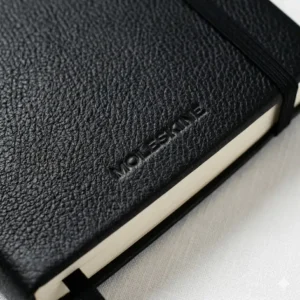
The Moleskine Classic Leather Portfolio is the brand’s own answer to the demand for a more rugged exterior. Crafted from soft, pebble-grain calf leather, it maintains the exact silhouette of the notebook itself.
Key Specifications:
-
Material: 100% genuine calf leather with a textured finish.
-
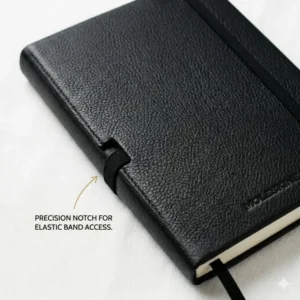
Closure: Signature elastic band integrated through the cover.
Expert Opinion:
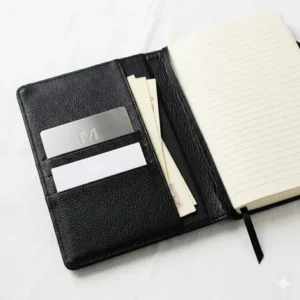
In my experience, this is the safest bet for someone who doesn’t want to overthink their setup. What most buyers overlook is the internal pocketing; it’s designed to hold the “In case of loss” labels and loose papers that Moleskine users typically accumulate. It is a “vanilla” choice, but it’s high-quality vanilla. It’s best for the professional who needs to maintain a sleek, corporate-appropriate aesthetic in boardrooms where a rugged, “cowboy-style” leather might look out of place.
Customer Feedback Summary:
Users generally praise the soft hand-feel and the fact that it fits the notebook like a second skin. Some note that the elastic can eventually stretch if you overstuff the internal pockets…
-
✅ Pros: Perfect fit, low profile, professional look.
-
❌ Cons: Thin leather, elastic can wear out.
Value Verdict:
In the $45-$60 range, this is a solid entry-level luxury item that honors the original design language of the brand.
2. Galen Leather Zippered Moleskine Folio — The Ultimate Workstation
When you need to carry your entire life inside your notebook, the Galen Leather Zippered Folio is the gold standard. This isn’t just a cover; it’s an organizational beast.
Key Specifications:
-
Material: Hand-dyed Crazy Horse leather that develops a high-contrast patina.
-
Storage: 4 card slots, a pen loop, and a removable 4-slot pen holder.
Expert Opinion:
The spec sheet says “zippered closure,” but what that really means in practice is peace of mind. If you are a fountain pen enthusiast or someone who keeps receipts, stamps, and loose polaroids in your journal, this cover prevents them from falling out in your bag. The Crazy Horse leather is thick—about 2mm—which provides a substantial “thud” when you set it on a desk. It’s best for travelers and “chaos” note-takers who need one place for everything.
Customer Feedback Summary:
Reviews often highlight the “distressed” look that arrives out of the box, with many users loving how it “heals” its own scratches over time. A few mentions of it being “bulky” for small bags are common…
-
✅ Pros: Incredible storage, lifetime durability, beautiful patina.
-
❌ Cons: Significant bulk, higher price point.
Value Verdict:
Retailing in the $95-$130 range, it is an investment piece that will likely outlive the person who buys it.
3. Hide & Drink Rustic Leather Case — Rugged Simplicity
For those who want a moleskine leather cover that looks like it was found in an abandoned 19th-century library, Hide & Drink delivers high-character leather at an accessible price.
Key Specifications:
-
Material: Full-grain Suede or Bourbon leather.
-
Build: Single-piece construction with heavy-duty fire-swaged brass snaps.
Expert Opinion:
Don’t let the lower price range fool you; the leather quality here is exceptional. What you’re sacrificing is “finish.” This is raw, rustic leather that will smell like a saddle shop for the first month. In my experience, this is the best choice for artists and outdoor enthusiasts. The 10-year warranty is a testament to the simplicity of the design—there are no zippers or elastics to break. It’s for the person who wants their journal to look like a rugged artifact.
Customer Feedback Summary:
Buyers are consistently shocked by the thickness of the leather relative to the cost. Some have noted that the fit is “snug” initially and requires a week of “breaking in” to close comfortably…
-
✅ Pros: Extremely affordable, heavy-duty hide, 10-year warranty.
-
❌ Cons: Very rustic (not for formal offices), initial stiffness.
Value Verdict:
At around $20-$35, this is the “best bang for your buck” for anyone who values durability over features.
4. Sojourner Leather Folio (Moleskine Large) — The Artisan’s Choice
The Sojourner brand has built a cult following in the stationery community for their minimalist “folio” style covers that emphasize the beauty of the leather itself.
Key Specifications:
-
Material: Horween leather or premium Wickett & Craig skirting.
-
Design: Simple slip-on folio with no closure, allowing the leather to wrap naturally.
Expert Opinion:
This is the “purist” choice. Using Horween leather—the same stuff used for NFL footballs—means the tactile experience is unmatched. What most buyers overlook is the “skiving” (thinning) of the edges, which makes the cover feel much thinner in the hand than it actually is. It’s best for the minimalist writer who hates bulk and wants their journal to lay flat on a table. The absence of a pen loop or pocket keeps the focus entirely on the writing experience.
Customer Feedback Summary:
Fans of the brand rave about the smell and the way the leather “molds” to the notebook over time. Occasional complaints focus on the lack of a closure mechanism for those who carry their journals loosely…
-
✅ Pros: Premium leather sourcing, excellent “lay-flat” ability, minimalist.
-
❌ Cons: No storage for pens, premium pricing.
Value Verdict:
In the $60-$85 range, you are paying for the quality of the hide and the craftsmanship of a small-batch maker.
5. Gfeller Casemakers Natural Skirting Cover — The Heirloom Standard
If you want the absolute pinnacle of moleskine leather cover craftsmanship, Gfeller Casemakers (originally famous for geologists’ tool cases) offers a “Natural Skirting” cover that is legendary in the EDC (Everyday Carry) world.
Key Specifications:
-
Material: Heavyweight natural vegetable-tanned skirting leather.
-
Fit: Wet-molded to the exact dimensions of a Moleskine Large.
Expert Opinion:
The “Natural Skirting” arrives looking almost white or pale pink. The transformation this cover undergoes is incredible; after a year of handling, it turns a deep, mahogany brown. The spec sheet won’t tell you this, but because this leather is so stiff, it acts as a portable desk, allowing you to write comfortably even when you’re standing or sitting on a park bench. It’s best for the connoisseur who appreciates the “slow burn” of leather aging.
Customer Feedback Summary:
Users report that these covers are nearly indestructible. A common tip from the community is to apply a light coat of Neatsfoot oil early on to speed up the tanning process…
-
✅ Pros: Unrivaled structural integrity, dramatic patina, professional-grade.
-
❌ Cons: Very expensive, requires maintenance (oiling).
Value Verdict:
Priced between $110-$150, this is the “Buy It For Life” (BIFL) choice for the serious journaler.
✨ Don’t Miss These Exclusive Deals!
🔍 Take your journaling to the next level with these carefully selected products. Click on any highlighted item to check current pricing and availability. These tools will help you create authentic records your family will love!
Practical Usage Guide: How to “Break In” and Maintain Your New moleskine leather cover
Buying a high-quality leather cover is only the first step. Because leather is a natural, fibrous material, it requires a “break-in” period and ongoing care to reach its full potential. If you’ve ever bought a pair of high-end boots, you know the drill: the first few days feel stiff, but the eventual fit is worth the wait.
The Initial Break-In (Days 1–14)
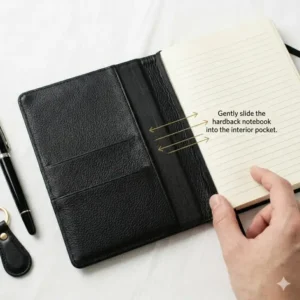
When you first slide your Moleskine into a thick leather cover, you might find it difficult to close, or the notebook might “spring” open. This is normal.
-
The “Weight” Method: Place two or three heavy books on top of your covered journal overnight. This compresses the fibers at the spine and encourages the leather to take the “folded” shape.
-
The Pocket Stretch: If your cover has card slots, don’t overstuff them immediately. Add one card per slot for the first week, then two. Forcing five cards in at once can permanently deform the leather or pop the stitching.
Long-Term Maintenance
A moleskine leather cover is thirsty. Depending on your climate, the leather can dry out and crack over time.
-
Cleaning: Use a damp (not wet) microfiber cloth to wipe away dust once a month.
-
Conditioning: Every 6 months, apply a tiny amount of leather balm (like Smith’s or Otter Wax). This keeps the fibers supple and water-resistant.
-
The Scuff Solution: If you get a light scratch, don’t panic. Use the heat from your thumb to rub the area in a circular motion. The natural oils in the leather (and your skin) will often “heal” the mark.
Real-World Scenarios: Which moleskine leather cover Fits Your Life?
Choosing a cover depends entirely on your environment. Let’s look at three common user profiles for 2026.
The Digital Nomad (Remote Tech Worker)
You spend your days in coffee shops, coworking spaces, and airport lounges. You need organization and protection against spills.
-
Recommendation: Galen Leather Zippered Folio.
-
Why: You likely carry an Apple Pencil or a high-end fountain pen. The zippered closure ensures your expensive tools don’t roll under a cafe table, and the thick leather provides a buffer against the occasional latte splash.
The Field Researcher / Architect
You are constantly on the move, taking notes while standing, and your notebook is subjected to the sun, wind, and grit.
-
Recommendation: Gfeller Casemakers Natural Skirting.
-
Why: You need the “portable desk” feel of stiff skirting leather. The natural tanning process means the sun actually makes your cover look better, not worse. It can handle being tossed into a tool bag without a second thought.
The Daily Journaler (Morning Pages / Reflection)
Your notebook stays mostly on your nightstand or in a clean backpack. You value the sensory, “cozy” feeling of your morning ritual.
-
Recommendation: Sojourner Leather Folio or Moleskine Classic Leather.
-
Why: You don’t need zippers or snaps. You want a cover that feels soft to the touch and lets the notebook lay perfectly flat so you can write from edge to edge without a “bump” under your palm.
How to Choose a moleskine leather cover: The Expert Framework
Choosing the right cover is about more than just picking a color. You need to consider the “anatomy” of the leather and the construction. Here is a 5-step framework to guide your purchase:
-
Identify Your Notebook Size: This is the most common mistake. Moleskine “Pocket” (3.5 x 5.5 in), “Large” (5 x 8.25 in), and “XL” (7.5 x 9.75 in) are proprietary sizes. A “Standard A5” cover will often be too wide for a Moleskine Large, leading to a “sloppy” fit. Always look for covers explicitly marketed as a moleskine leather cover.
-
Choose Your Tanning Type: * Chrome Tanned: Soft, consistent color, water-resistant, but doesn’t patina much.
-
Vegetable Tanned: Stiff initially, smells like wood/earth, develops a massive patina, more eco-friendly.
-
-
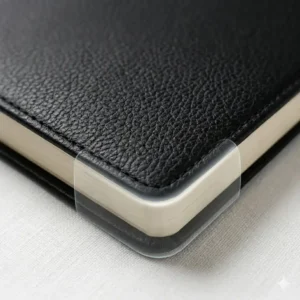
Check the Stitching: Look for “saddle stitching” (hand-stitched) if you want maximum durability. If one thread breaks in a machine “lock-stitch,” the whole line can unravel. In a saddle stitch, the threads are independent.
-
Evaluate the “Bulk Factor”: Do you carry your notebook in a back pocket? If so, avoid covers with snaps or thick pen loops. If it lives in a bag, bulk doesn’t matter, and a zipper becomes a benefit.
-
Assess the ROI: A $100 cover might seem expensive, but if you fill two notebooks a year and keep the cover for 10 years, that’s $5 per notebook for a premium experience. It’s cheaper than buying “disposable” plastic covers that break every six months.
Full Grain vs. Top Grain: The Truth About Leather Quality
Marketing terms can be deceptive. You will see “Genuine Leather” stamped on many cheap products, but in the leather industry, “Genuine” is often the lowest grade of real leather (essentially the “particle board” of the hide world).
For a moleskine leather cover, you should aim for Full Grain. This is the top layer of the hide, including all the natural grain and “imperfections.” It is the strongest part of the animal skin. Top Grain is the second-highest grade; the very top surface has been sanded down to remove scars. While Top Grain is more “uniform” and often softer, it loses the structural integrity of Full Grain.
In my experience, Full Grain is the only way to go for a notebook cover. Why? Because a notebook cover is constantly being opened, closed, and flexed. Full Grain fibers are tight and interlocking, meaning they won’t “delaminate” or peel over time. If you see a cover for under $15, it is almost certainly “bonded leather” (shredded leather scraps glued together). Avoid this; it will look terrible within three months of daily use.
Dealing with Scratches, Patina, and “The First Mark”
There is a psychological hurdle every new leather owner faces: the first scratch. You’ve spent $80 on a beautiful, pristine moleskine leather cover, and then your keys gouge a line right across the front.
Expert Advice: Embrace it. Leather is an “organic” record of your life. In the leather community, we call this “character.” High-quality leathers like Horween or Crazy Horse are designed to be “pull-up” leathers, meaning they contain high concentrations of oils and waxes. When the leather is scratched, the oils move around, often lightening the color.
If you truly hate the look of a scratch, you can use a hairdryer on a medium setting for 30 seconds to “re-mobilize” the oils in that area, then rub it out with your thumb. However, the most beautiful covers are the ones that look like they’ve been through a war zone. By the year 2026, the “rugged-worn” aesthetic is more than just a trend; it’s a badge of authenticity in a world of plastic-wrapped tech.
Why Moleskine Specifically? The Fit Issue
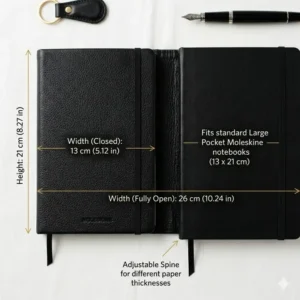
You might wonder why you can’t just use a generic “journal cover.” The reason lies in Moleskine’s unique dimensions. According to the official Moleskine History, the brand revived a traditional French notebook style. Their “Large” size is 13x21cm. This is slightly narrower than the international A5 standard (14.8x21cm).
If you put a Moleskine into a standard A5 leather cover, there will be about 1.8cm of “dead space” on the right side. This makes the notebook feel unstable and causes the leather to flop over the edge. A dedicated moleskine leather cover is wet-molded or measured to that specific 13cm width. This “snugness” is what provides the structural support needed to write comfortably while on the go.
Common Mistakes When Buying a moleskine leather cover
After years of testing stationery accessories, I’ve seen buyers make the same three mistakes repeatedly:
-
Ignoring Paper Thickness: If you use the “Moleskine Expanded” version (which has 400 pages instead of the standard 240), it will NOT fit in 90% of leather covers. Always check the “spine width” compatibility.
-
Over-Conditioning: New leather usually doesn’t need oil. If you apply too much conditioner to a new cover, you can make the leather “mushy” and ruin the structural integrity. Wait at least 6 months before your first treatment.
-
Assuming All Leather is Waterproof: Leather is naturally water-resistant, but it is not waterproof. If your cover gets soaked, do NOT put it on a radiator. High heat will bake the natural oils out, making the leather brittle and prone to cracking. Let it air dry slowly at room temperature.
The Economics of Journaling: The ROI of Leather
Let’s talk about the “Total Cost of Ownership.” A standard Moleskine notebook costs roughly $20-$30. If you are a heavy user, you might go through three a year. Over five years, that’s $300-$450 in notebooks.
Spending $70 on a moleskine leather cover might feel like a “luxury” add-on. However, consider the protection. I have seen countless notebooks ruined because a water bottle leaked in a bag or the cardboard cover simply detached from the spine due to humidity. The leather cover acts as an insurance policy. It protects your data (your thoughts). Furthermore, the psychological value is real: when your notebook feels like a premium object, you are more likely to treat the contents with respect and use it consistently. In that sense, a leather cover isn’t just an accessory; it’s a productivity tool.
✨ Don’t Miss These Exclusive Deals!
🔍 Take your organization to the next level with these carefully selected products. Click on any highlighted item to check current pricing and availability. These tools will help you create authentic records your family will love!
Conclusion
Choosing the right moleskine leather cover is a deeply personal decision that balances aesthetics, utility, and budget. Whether you opt for the official Moleskine Classic Leather Portfolio for its sleek lines, or the Gfeller Casemakers for its “geologist-grade” durability, you are making an investment in your intellectual legacy. In 2026, where everything is ephemeral and stored in the cloud, there is a profound power in holding a heavy, leather-bound volume of your own thoughts. It is an anchor in a digital storm. Protect your notebook, and it will protect your history.
❓ FAQs
❓ Will a moleskine leather cover fit other notebook brands?
✅ It depends on the size. Because Moleskine is narrower than A5, a Moleskine-specific cover will be too tight for a Leuchtturm1917 or a Rhodia Webie. However, it will usually fit “slim” A5 notebooks like the Midori MD quite well…
❓ Does the leather cover make the notebook heavy?
✅ Yes, significantly. A full-grain leather cover can add 150g to 300g to your carry. If you are a light-packer, look for “Goat Leather” or “Calf Leather” options, which are thinner and lighter than heavy cowhide skirting…
❓ Can I use a leather cover with a softcover Moleskine?
✅ Absolutely. In fact, leather covers are better for softcover notebooks because they provide the rigidity that the notebook lacks. It turns a “floppy” notebook into a hard-surface writing platform…
❓ How do I get rid of the strong “leather smell”?
✅ The “tannery smell” comes from the vegetable oils and dyes. The best way to dissipate it is to leave the cover in a well-ventilated room (not direct sunlight) for 48 hours. Using it daily will also help it absorb your scent…
❓ Will the leather dye rub off on my clothes?
✅ High-quality covers are “drum-dyed” and sealed. However, with “Crazy Horse” or oil-tanned leathers, there can be a slight “crocking” (color transfer) if the leather gets wet. Be careful with white linen pants in the first month…
Recommended for You
- 5 Best travelers notebook cover Picks for 2026: A Masterclass in Analog
- Huge Journal: 7 Best Giant Notebooks for Massive Ideas in 2026
- Large journal: 7 Best Oversized Notebooks to Boost Creativity in 2026
Disclaimer: This article contains affiliate links. As an Amazon Associate, I earn from qualifying purchases. If you purchase products through these links, we may earn a small commission at no additional cost to you.
✨ Found this helpful? Share it with your friends! 💬🤗
[addtoany]
