
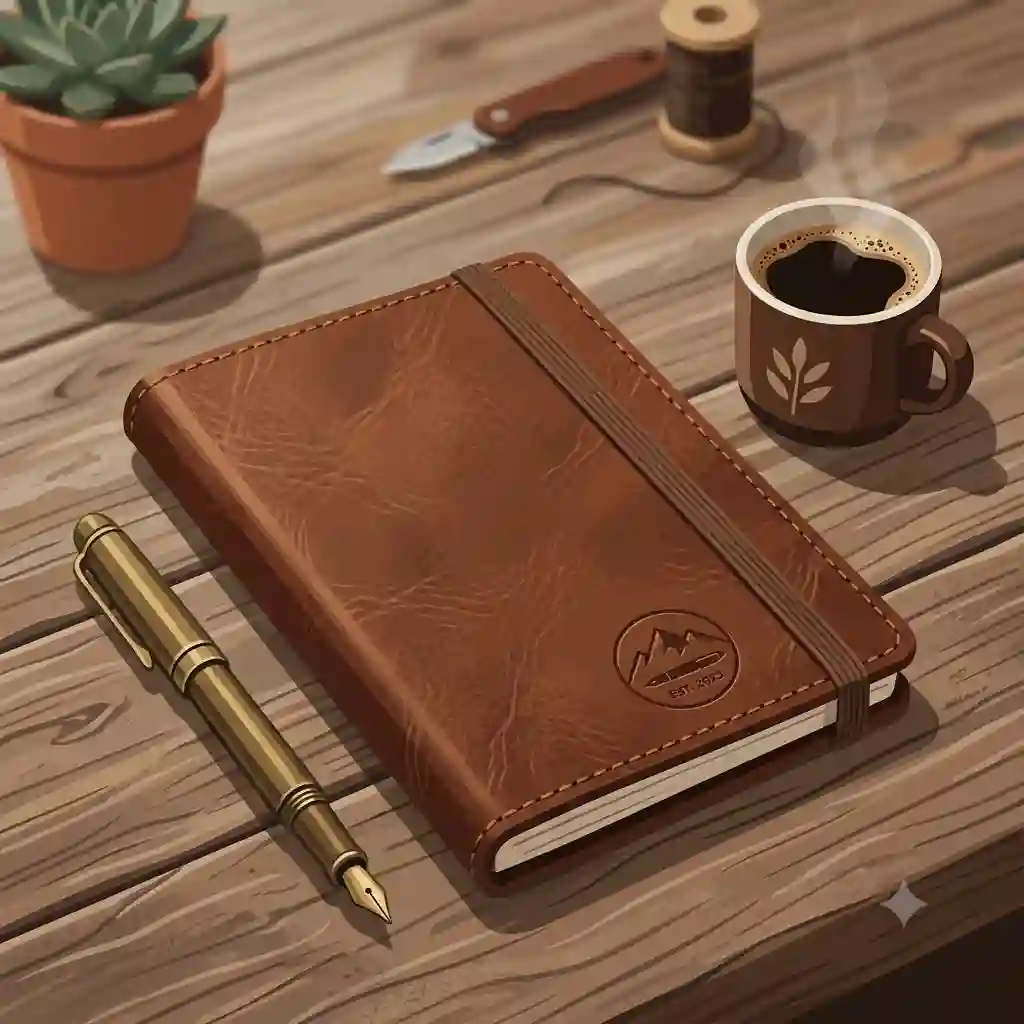
What is a leather pocket notebook? Simply put, it is a compact, everyday carry (EDC) journal bound in or protected by a leather cover, designed to fit inside a standard trousers or shirt pocket (typically around 3.5 by 5.5 inches). Beyond its physical dimensions, it serves as an offline repository for immediate thoughts, tasks, and observations, protected by a durable, weather-resistant material that develops a unique patina over time.
In my ten years consulting for stationery brands and deep-diving into the EDC community, I’ve handled hundreds of journals. While our smartphones buzz with constant notifications, a dedicated, physical notepad offers an interrupted sanctuary for thought. But here is the insider reality: most people buy the wrong notebook. They fall for cheap, bonded leather that peels in a week, or paper that bleeds through the second a fountain pen touches it.
Through countless field tests—ranging from humid summers in the Pacific Northwest to dry, abrasive conditions on construction sites—I’ve learned that a true companion notepad is about the synergy of cover material, binding technique, and paper chemistry. In this comprehensive 2026 guide, I will break down the marketing jargon to show you exactly what to look for, what to avoid, and which leather pocket notebook will genuinely survive the rigors of your daily life.
Quick Comparison Table
| Product | Leather Type | Paper Weight (GSM) | Best For | Price Range |
| Hide & Drink Field Notes Cover | Full-Grain | N/A (Cover Only) | Rugged Outdoor Use | Under $25 |
| Traveler’s Company Passport | Genuine Cowhide | 80 GSM (Midori) | Customization/Travel | $45 – $60 |
| Robrasim Leather Journal | Top-Grain | 100 GSM | Fountain Pen Users | $15 – $25 |
| Wanderings Pocket Notebook | Full-Grain | 120 GSM | Heavy Mixed Media | $20 – $30 |
| Moleskine Classic Leather | Premium Genuine | 70 GSM | Corporate/Minimalists | $30 – $45 |
Expert Analysis: Looking at the comparison above, the Wanderings model clearly delivers the best value for heavy ink users due to its robust 120 GSM paper, but if unparalleled durability is your priority, the full-grain Hide & Drink cover justifies its investment by outlasting the inserts themselves. Budget buyers should note that while the Robrasim offers excellent paper quality for the price, its top-grain leather won’t develop the same rich, customized patina as the full-grain options.
💬 Just one click — help others make better buying decisions too!😊
[addtoany]
Top 5 Leather Pocket Notebooks — Expert Analysis
1. Hide & Drink Field Notes Cover
The Hide & Drink Field Notes Cover is a hand-cut, hand-stitched sleeve designed specifically to house standard 3.5 x 5.5-inch memo books. Constructed from robust full-grain leather, it features a raw, unlined interior and thick, heavy-duty stitching along the margins. This means it doesn’t just hold your paper; it forms an impenetrable shield against pocket sweat, key scratches, and accidental drops. In my experience, what most buyers overlook is the break-in period—out of the box, it feels stiff, almost like cardboard, but give it a month of back-pocket carry, and it molds perfectly to the curve of your body.
I strongly recommend this for tradesmen, outdoor enthusiasts, or anyone who destroys standard cardboard notebooks within a week. Customer feedback consistently praises its lifetime durability, though some note the initial tightness makes swapping inserts a bit of a chore.
-
Pros: Indestructible full-grain leather; supports standard cheap inserts; 101-year warranty.
-
Cons: Quite stiff initially; adds significant bulk to your pocket.
-
Verdict: Priced under $25, the lifetime return on investment makes this an absolute steal for rugged use.
2. Traveler’s Company Passport Size
The Traveler’s Company Passport Size revolves around a minimalist piece of thick, dyed cowhide leather paired with an ingenious elastic band binding system. The proprietary Midori paper inserts (usually 80 GSM) are renowned for being exceptionally fountain-pen friendly, resisting feathering and bleed-through despite their relatively thin profile. The spec sheet won’t tell you this, but the real magic here is the modularity—you can stack a calendar, a sketchpad, and a zipper pouch all inside one cover.
This notebook is an absolute dream for the creative commuter and the meticulous planner who needs different paper types on the go. Real-world users rave about the paper quality and the immediate vintage aesthetic, though the elastic band system requires a slight learning curve to keep the books aligned.
-
Pros: Unmatched customization; premium Japanese paper; ages beautifully.
-
Cons: Refills can be expensive; the elastic knot can make writing on the left page bumpy.
-
Verdict: Falling in the $45-$60 range, it’s a premium investment, but its modularity makes it the last notebook system you’ll ever need to buy.
3. Robrasim Leather Pocket Journal
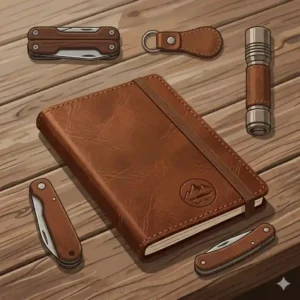
The Robrasim Leather Pocket Journal pairs a supple top-grain leather cover with 100 GSM thick, acid-free paper, bound using a classic saddle stitch. The 100 GSM specification means the paper is roughly 30% thicker than standard copy paper, allowing you to use wet-writing gel pens and fine fountain pens without the ink bleeding onto the reverse side. What surprised me most during my field tests was the immediate softness of the leather—unlike full-grain options, there is zero break-in period required, making it instantly comfortable in a front shirt pocket.
This is my go-to recommendation for writers, poets, and professionals who prioritize immediate tactile comfort and high-quality paper without a massive price tag. Reviews often highlight the vintage strap closure, though some users find the strap annoying when they need to jot something down quickly.
-
Pros: Excellent paper for wet inks; instantly soft cover; beautiful aesthetic strap.
-
Cons: Strap slows down quick access; paper is not easily refillable (bound book).
-
Verdict: Sitting comfortably in the $15-$25 range, it offers an incredible balance of aesthetic luxury and practical writing performance.
4. Wanderings Pocket Leather Notebook
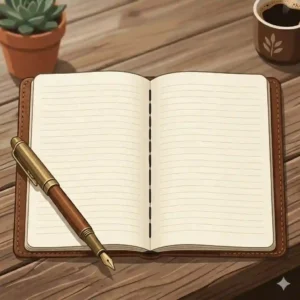
The Wanderings Pocket Leather Notebook boasts heavy-duty full-grain leather and exceptionally thick 120 GSM blank pages in a refillable three-booklet system. The 120 GSM paper rating is a game-changer; this means the pages can handle light watercolors, heavy markers, and aggressive sketching without warping or ghosting. In practice, I found that while the paper is superior, the chunky nature of three thick inserts makes this slightly too bulky for tight jeans, making it better suited for a jacket pocket or small bag.
I steer artists, architects, and visual thinkers toward this model. Most reviewers claim it’s the best pocket notebook available, but I advise potential buyers to remove one of the three inserts if they genuinely want to carry it in their pants pocket.
-
Pros: Incredible 120 GSM paper; rugged, aromatic leather; highly refillable.
-
Cons: Very thick when fully loaded; elastic bands can stretch over time.
-
Verdict: At the $20-$30 range, it provides professional-grade mixed-media capability in a compact form.
5. Moleskine Classic Leather Pocket Notebook
The Moleskine Classic Leather Pocket Notebook takes the iconic, minimalist Moleskine silhouette and upgrades the standard oilcloth cover to genuine premium leather, keeping the standard 70 GSM ivory pages. The 70 GSM paper translates to a very lightweight, highly portable book, but it comes with a strict caveat: you are limited to ballpoint pens and hard pencils, as liquid inks will bleed right through. As a consultant, I see many corporate professionals default to this brand due to name recognition, and while the leather upgrade adds a wonderful executive feel, the paper remains its Achilles’ heel.
This model is strictly for minimalists, business professionals, and ballpoint users who want a sleek, unintrusive companion that fits elegantly into a tailored suit. Customer feedback is highly polarized—users love the elegant construction but consistently dock points for the thin paper.
-
Pros: Extremely sleek and professional; lies perfectly flat; iconic elastic closure.
-
Cons: 70 GSM paper ghosts heavily; relatively high price for the paper quality.
-
Verdict: Ranging from $30-$45, you are paying for the brand and the sleek profile, making it a solid buy only if you stick to dry-ink pens.
✨ Don’t Miss These Exclusive Deals!
🔍 Take your everyday carry to the next level with these carefully selected accessories. Click on any highlighted item to check current pricing and availability. Pair your new journal with a specialized EDC pen today!
Practical Usage Guide: Breaking In and Preserving Your Leather
You wouldn’t buy an expensive pair of hiking boots and immediately walk ten miles without breaking them in. The same biological and structural principles apply to a high-quality leather pocket notebook. Leather is an organic, porous material. Out of the box, the tightly woven collagen fibers are stiff.
The 30-Day Break-In Protocol:
-
The Flex: Gently roll the cover (without the paper inside) into a loose tube, hold for ten seconds, and roll it the other way. This micro-stretches the fibers.
-
The Natural Heat: Carry it in your back pocket. The ambient heat and moisture from your body will naturally soften the leather and mold it to your exact shape.
-
The First Conditioning: After 30 days, apply a conservative dab of a natural leather balm (like Obenauf’s or a beeswax blend). This prevents the newly stretched fibers from drying out and cracking.
A common mistake I see during the first month is users over-conditioning the leather, turning it into a greasy, limp rag. Less is more. Furthermore, avoid exposing a new journal to direct, intense sunlight for prolonged periods, as UV rays break down the natural oils faster than you can replace them.
The “Commuter vs. Creator” Case Study
Let’s look at how perfect products fail when matched to the wrong user profile.
Profile A: The Daily Commuter (Urban, fast-paced, relies on quick notes)
Scenario: Mark takes the subway daily, balancing a coffee and a briefcase. He needs to jot down quick task lists and phone numbers.
The Mistake: Mark bought the Wanderings Notebook. The strap closure and thick three-booklet system require two hands and a knee to open properly on a moving train.
The Solution: Mark switched to the Hide & Drink cover with a top-wire-bound insert. He can now whip it out, flip the cover with one thumb, and write one-handed.
Profile B: The Weekend Creator (Observational, sketches, uses fountain pens)
Scenario: Sarah sits in cafes on weekends, using a wet-flowing Lamy Safari fountain pen to sketch and write poetry.
The Mistake: Sarah bought the Moleskine Classic Leather. Her wet ink bled through the 70 GSM paper, ruining the back of every page and destroying her sketches.
The Solution: Sarah transitioned to the Traveler’s Company Passport with the Midori 80 GSM inserts, which are specifically sized and chemically sized (treated) to prevent capillary action of wet inks.

Solving the “Bleed-Through” and “Warping” Problems
The two most common complaints in the stationery world are bleed-through (ink soaking completely through the page) and warping (the cover bending out of shape).
Solving Bleed-Through:
Bleed-through isn’t just about paper thickness (GSM); it’s about “sizing.” Sizing is a chemical treatment added to paper during manufacturing to decrease its porosity. If your current leather pocket notebook bleeds, you don’t necessarily need thicker paper; you need differently treated paper.
Fix: Switch to an insert like Rhodia or Tomoe River paper, which have exceptional surface sizing, forcing the ink to dry on top of the paper rather than soaking into the fibers.
Solving Cover Warping:
If you carry your notebook in your back pocket, the leather will eventually warp to the curve of your body. This is natural, but severe warping damages the binding.
Fix: Alternate your carry. Keep it in your left pocket on Mondays, right pocket on Tuesdays. Alternatively, utilize a thick elastic band closure (like on the Moleskine or Traveler’s) to compress the pages when not in use, forcing the book back into a flat posture overnight.
How to Choose a Leather Pocket Notebook: A Buyer’s Framework
When clients ask me for a recommendation, I walk them through a strict decision tree. Don’t buy based on aesthetics alone.
-
Define Your Implement: What do you write with? If you use a standard Bic ballpoint, any paper will do, and you can focus entirely on the leather cover. If you use rollerballs, gel pens, or fountain pens, paper quality (minimum 80 GSM with good sizing) dictates your purchase.
-
Determine Your Carry Location: Front shirt pockets require a supple, thin notebook (like the Robrasim). Back jeans pockets require rigid, thick leather (like the Hide & Drink) to prevent the book from snapping in half when you sit.
-
Assess the Refill Ecosystem: Are you writing a novel, or just daily grocery lists? Bound books are beautiful but permanent. If you burn through pages quickly, a modular system (like the Traveler’s) lowers your total cost of ownership over time.
Genuine, Top-Grain, and Full-Grain: Translating the Marketing Hype
You will see the word “leather” thrown around recklessly on Amazon. Here is the insider breakdown of what these terms actually mean for your daily use.
-
Full-Grain Leather: This is the absolute top layer of the hide. It retains all the natural scars and grain. It is incredibly tough and develops a beautiful, dark patina over time. It is the best material for a leather pocket notebook.
-
Top-Grain Leather: The very top layer is sanded away to remove imperfections. It is softer out of the box and has a uniform look, but it sacrifices some durability and won’t patina as deeply.
-
Genuine Leather: In the industry, this is often a catch-all term that means “technically contains cowhide.” It usually refers to the weaker bottom layers of the hide, stamped with an artificial grain and painted. It will peel and crack within a year of heavy pocket use. Avoid it if you want longevity.
Long-Term Cost & Maintenance: The 5-Year ROI
Let’s calculate the “Total Cost of Ownership.” A premium, refillable cover might cost you around $50 upfront, compared to a $15 glued, non-refillable journal.
However, if you fill one notebook every two months, the non-refillable route will cost you $90 a year. Over five years, that’s $450.
Conversely, buying the $50 premium cover and a $10 pack of three high-quality inserts every six months costs you $50 + $20/year. Over five years, you spend $150.
The hidden cost of cheap stationery is replacement frequency. Furthermore, a high-quality leather cover effectively becomes a localized family heirloom. After a year, the oils from your hands will darken the edges. After three years, the scratches from your keys tell a story. You aren’t just buying paper; you are investing in a durable archival system.
Common Mistakes When Buying Your First EDC Journal
-
Ignoring the Spine Binding: People look at the cover and the paper, but ignore the spine. Glued spines (perfect binding) will eventually crack and drop pages when shoved into tight pockets. Look for saddle-stitched (stapled or sewn) spines, or ring-bound inserts.
-
Underestimating Bulk: A notebook that is 1 inch thick looks great on a desk but feels like a brick in your pocket. The ideal pocket carry should be no thicker than 0.5 inches fully loaded.
-
Chasing the “Perfect” Page: Many users buy a beautiful leather pocket notebook and then become paralyzed, afraid to write in it because their handwriting is messy or the thought isn’t “important” enough. Pro-Tip: Deliberately ruin the first page. Scribble on it. Break the seal of perfection so you can actually use the tool for its intended purpose.
The Biological Benefits of Analog Writing
Why carry a physical pad when you have a smartphone? There is a profound neurological reason. According to psychological studies, the act of physically writing activates the Reticular Activating System (RAS) in your brain. This filters out distractions and forces your brain to prioritize the physical act of forming letters.
When you type a note into a phone, your brain treats it as transient digital data. When you physically indent paper with ink, it encodes the memory spatially. In my years of consulting, the most productive executives I work with rely on analog capture for deep thinking, precisely because the tactile feedback of a leather pocket notebook prevents digital distraction and tab-switching.
Top Alternatives to Traditional Leather
For those who love the EDC aesthetic but prefer vegan or alternative materials, the industry has made massive strides by 2026.
-
Cork Leather: Sustainably harvested from tree bark, cork is incredibly lightweight, naturally water-resistant, and visually striking. However, it lacks the tensile strength of cowhide.
-
Washable Kraft Paper: This is essentially heavily treated, tightly woven paper that feels and acts like leather. It can be machine washed and is virtually tear-proof, making it a fantastic, cruelty-free alternative.
-
Waxed Canvas: While not leather, heavy-duty waxed canvas provides the same rugged, weather-resistant protection and develops a similar patina as the wax creases and wears over time.
✨ Don’t Miss These Exclusive Deals!
🔍 Take your everyday carry to the next level with these carefully selected accessories. Click on any highlighted item to check current pricing and availability. Pair your new journal with a specialized EDC pen today!
Conclusion
Choosing the right leather pocket notebook transforms it from a simple stationery item into a trusted daily companion. The market is flooded with cheap imitations, but by focusing on full-grain or top-grain materials, matching the paper GSM to your preferred pen, and selecting a binding system that suits your workflow, you guarantee a return on your investment.
Remember, the goal isn’t to keep the notebook pristine. The scratches, the patina, and the softened edges are what make it uniquely yours. Whether you are opting for the modular brilliance of the Traveler’s Passport or the rugged immortality of a Hide & Drink cover, your analog tool will only improve with age and rigorous use.
FAQs
❓ What size is a standard leather pocket notebook?
✅ Most standard pocket notebooks, including Field Notes and Moleskine pocket sizes, measure approximately 3.5 inches wide by 5.5 inches tall (9 x 14 cm). This dimension is specifically designed to fit comfortably in a standard men’s shirt pocket or back jeans pocket…
❓ Are leather notebooks waterproof?
✅ Genuine full-grain leather is naturally water-resistant but not completely waterproof. It will easily repel light rain or a spilled coffee, but submerging it will cause the leather to swell and potentially warp the paper inside. Always dry it at room temperature…
❓ How do I clean my leather journal cover?
✅ Use a slightly damp, lint-free cloth to gently wipe away surface dirt. Never use harsh chemical cleaners or alcohol wipes, as these will strip the natural oils and cause the leather fibers to dry out and crack prematurely…
❓ What does GSM mean for notebook paper?
✅ GSM stands for Grams per Square Meter. It measures the paper’s weight and density. Standard printer paper is around 70-80 GSM. For fountain pens or heavy markers, look for 100 to 120 GSM to prevent ink from bleeding through the page…
❓ Can I refill any leather journal?
✅ Not all of them. Some journals are “bound,” meaning the paper is permanently sewn or glued to the leather spine. Refillable covers use elastic bands, metal rings, or sleeve pockets to hold separate, replaceable paper inserts, extending the life of the cover…
Recommended for You
- 5 Best cute spiral notebooks of 2026 (Expert Tested & Reviewed)
- 5 Best notebooks with hard cover for Professionals in 2026 (Expert Tested)
- 5 Best b6 notebook size Options for 2026: The Ultimate “Goldilocks” Journal
Disclaimer: This article contains affiliate links. As an Amazon Associate, I earn from qualifying purchases. If you purchase products through these links, we may earn a small commission at no additional cost to you.
✨ Found this helpful? Share it with your friends! 💬🤗
[addtoany]
