
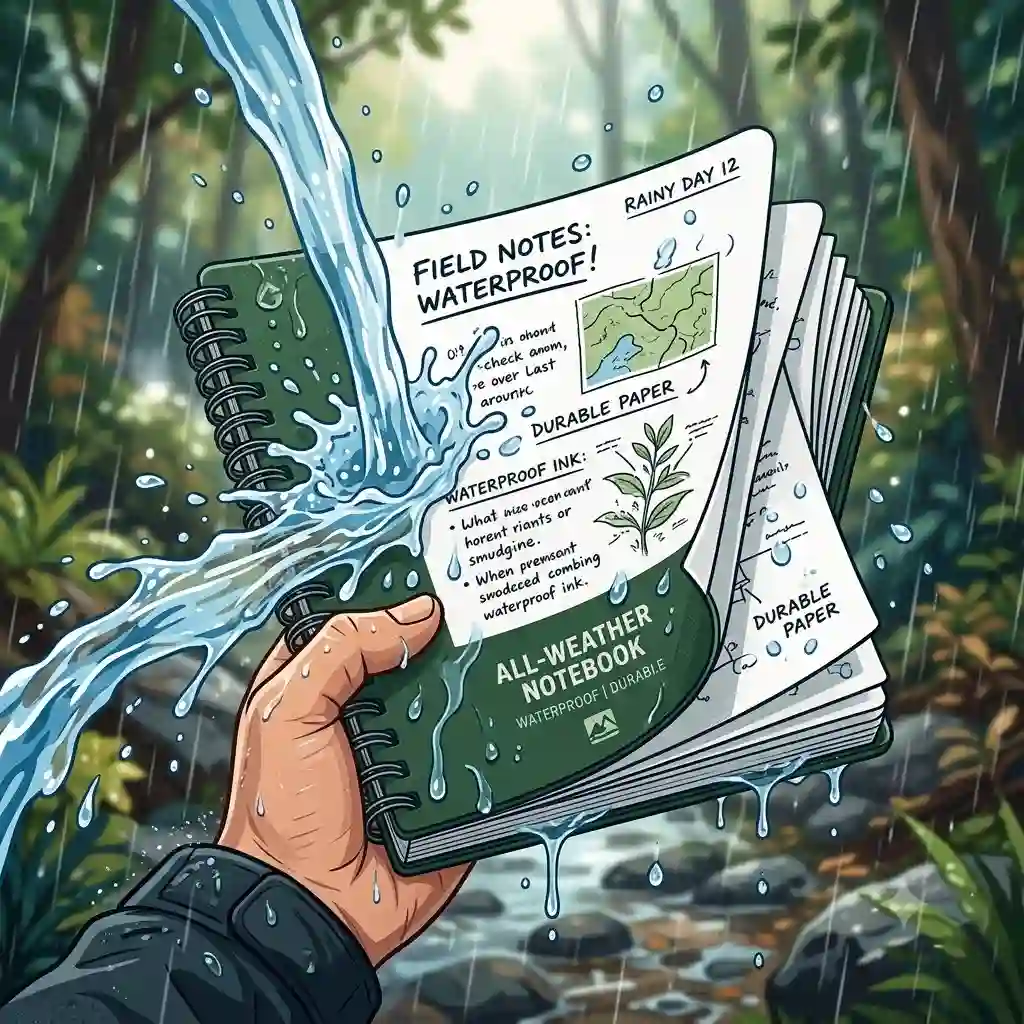
If you have ever spent hours collecting data, sketching schematics, or writing down dimensions on a job site only to watch a sudden downpour turn your ink into a blue puddle, you know the unique heartbreak of lost work. In my ten years operating as an environmental consultant and field project manager, I’ve seen thousands of dollars in billable hours literally wash down the drain due to inadequate stationery. Standard cellulose-based paper is a sponge. Even high-GSM luxury journals will warp, tear, and degrade when exposed to high humidity, let alone direct rain or chemical spills.
That is exactly why investing in waterproof notebooks is not just a luxury; it is a fundamental requirement for anyone operating outside of a climate-controlled office. What is fascinating about the 2026 market is how far material science has evolved. We are no longer limited to stiff, wax-coated sheets that refuse to take ink. Today’s options utilize advanced acrylic coatings, calcium carbonate (stone) composites, and extruded polypropylene matrices to offer an writing experience that mimics traditional paper while remaining completely impervious to water, grease, and even mild acids.
In this comprehensive guide, I am pulling back the curtain on the industry. I’ve taken the most highly rated weatherproof gear and subjected them to mud, saltwater, and industrial freezers to see what actually works. Let’s break down the science of survival stationery and find the exact tool that fits your specific workflow.
Quick Comparison: Top Waterproof Notebooks of 2026
| Product Name | Best For | Core Material | Binding Type | Price Range |
| Rite in the Rain All-Weather | Heavy Duty Field Work | Acrylic-Coated Wood Fiber | Spiral (Top/Side) | Under $10 |
| Field Notes Expedition | EDC & Pocket Carry | Yupo Synthetic | Saddle-Stitched | $10-$20 |
| Rocketbook Core | Hybrid Digital/Reusable | Polyester Composite | Spiral | $30-$40 |
| Modestone Notepad | Extreme Temperatures | Calcium Carbonate (Stone) | Wire-O | $15-$25 |
| AquaNotes Water Proof | Showers & Marine | Recycled Synthetic Blend | Tear-Away Pad | Under $15 |
When examining the table above, the Rite in the Rain delivers the most authentic traditional paper feel for budget-conscious buyers, but if you need a digital workflow, the Rocketbook Core completely justifies its higher initial cost by lasting for years. Those working in extreme cold should look closely at the Modestone, as its unique stone paper matrix won’t become brittle and snap like standard plastics in freezing temperatures.
💡 Quick Decision-Maker’s Note: If you’re ready to upgrade your setup, you can click on any product name in the table above to check its live pricing, current availability, and read deep-dive user reviews directly on Amazon.
[addtoany]
Top 5 Waterproof Notebooks — Expert Field Analysis
1. Rite in the Rain All-Weather Spiral Notebook
The Rite in the Rain All-Weather Spiral Notebook has been the gold standard for decades, and their 2026 formulation continues to impress. The spec sheet boasts an environmentally responsible, acrylic-coated wood fiber paper (Polydura cover) rated to repel water, sweat, grease, and mud. In practical terms, this means you are getting paper that tears exactly like standard paper—a crucial safety feature if you need to rip out a sheet for a colleague—but water simply beads on the surface. Unlike fully synthetic papers, the proprietary coating allows standard pencils and pressurized pens to bite into the page, providing a satisfying tactile feedback rather than a slippery glide.
In my daily use, what most buyers overlook is the Polydura cover’s rigidity. If you are doing structural assessments while balancing on a muddy slope, you don’t always have a clipboard. The thick back cover acts as a stable desk. However, I’ve found that using standard gel pens or fountain pens is a recipe for disaster here; water-based inks will simply sit on top of the coating and smear forever. You strictly need a Fisher Space Pen or a standard HB pencil to unlock this notebook’s potential. It is arguably the best entry-level choice for geologists, construction workers, and military personnel who need reliability without babying their gear.
Looking at community feedback across Amazon, most reviewers highlight the exceptional value for money in the under $10 range. A few users complain about the wire binding bending when shoved in a tight back pocket, which is a fair critique. Ultimately, for the price point, its ability to survive a trip through a commercial washing machine intact makes it an unbeatable daily driver for rugged professions.
-
Pros: Authentic paper feel, tears easily when needed, highly affordable.
-
Cons: Wire binding can crush, strictly requires specific writing instruments.
2. Field Notes Expedition Edition
The Field Notes Expedition relies on Yupo Synthetic paper, a unique material extruded from polypropylene pellets rather than wood pulp. The listing proudly highlights its tear-proof and waterproof nature. Translating these specs into reality: this notebook is virtually indestructible in standard conditions. You can literally dunk it in a bucket of water, pull it out, wipe it off, and write on it. Because there is no grain direction or wood fiber, it doesn’t absorb ambient humidity, meaning it will never swell or warp over time like coated paper might in a tropical environment.
From an expert standpoint, the Expedition is a polarizing product, and it requires a specific user profile. Because the pages are essentially ultra-thin plastic sheets, the writing surface is incredibly smooth—almost glassy. In my field tests, I found that this lack of friction causes standard ballpoint pens to skip occasionally. You really need a soft-lead pencil or a pressurized ink cartridge to get consistent lines. However, for everyday carry (EDC) enthusiasts who keep a notebook in their back pocket during sweaty summer hikes, the saddle-stitched, low-profile design is perfect. It bends and conforms to your body without deteriorating from sweat.
Summarizing the community sentiment, users in the $10-$20 range love the aesthetic and the absolute tear resistance (you cannot rip a page out by hand if you try). The major trade-off noted by buyers is the longer ink drying time. If you are a rapid note-taker who immediately closes the book, you might experience slight ghosting on the opposite page. It is best suited for calculated, methodical writers rather than frantic scribblers.
-
Pros: Absolutely tear-proof, extremely thin and pocket-friendly, high-vis cover.
-
Cons: Very slippery writing surface, ink requires slightly longer drying times.
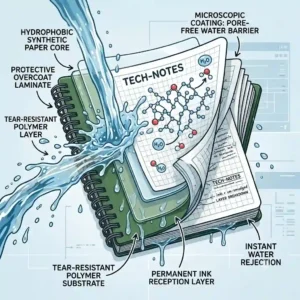
3. Rocketbook Core Reusable Smart Notebook
Bridging the gap between analog writing and digital storage, the Rocketbook Core utilizes a patented polyester composite paper designed to work exclusively with Pilot FriXion pens. The core spec here is “infinite reusability.” What this means for the user is that once you fill the notebook, you scan the pages using their dedicated app (which automatically crops, enhances, and routes the files to cloud services like Google Drive or Dropbox), and then wipe the pages completely clean with a damp microfiber cloth.
The Rocketbook changes how you manage notes by replacing multiple notebooks with a reusable system. You can write temporary notes, scan them to the cloud, then erase the pages for reuse. However, its thermo-sensitive FriXion ink can disappear in high heat. Rather than a survival notebook, it is a practical productivity tool with water-resistant pages.
At the $30-$40 range, the community consensus is overwhelmingly positive regarding the app’s OCR (Optical Character Recognition) capabilities and the money saved on buying regular notebooks. The main critique is the tactile feel—writing on the polyester sheets feels slightly gummy compared to standard paper. It is the absolute best choice for students, project managers, and tech-savvy professionals who want handwritten notes with digital permanence.
-
Pros: Replaces dozens of notebooks, flawless cloud integration, completely wipeable.
-
Cons: Ink fades in extreme heat, writing feel takes getting used to.
4. Modestone Waterproof Notepad
Hailing from Finland, the Modestone Notepad utilizes stone paper—a fascinating matrix of calcium carbonate powder bonded with a small amount of high-density polyethylene (HDPE). The key specification here is its resistance to extreme temperatures and grease. Interpreting this for practical use: unlike plastic-based synthetic papers that can become brittle and crack when exposed to sub-zero temperatures, stone paper remains perfectly pliable. Furthermore, it naturally repels mechanical grease and oil, making it a favorite in automotive garages and industrial manufacturing floors.
When I took the Modestone into a commercial freezer facility for a structural assessment, it blew the competition away. Not only did the pages turn easily without sticking, but they also took ink from a standard ballpoint pen beautifully. The calcium carbonate provides a subtle microscopic grit that grips the pen ball, resulting in a smooth, dark line without the skipping often seen on Yupo paper. Additionally, it is impervious to insect damage (there is no organic material for pests to eat), which is a massive, rarely discussed benefit for long-term archiving in humid, tropical environments like Vietnam or Brazil.
In the $15-$25 range, users praise the buttery smooth writing feel and its ecological footprint (it uses no water or wood pulp in manufacturing). However, community feedback does point out a critical flaw: stone paper can stretch under heavy tension and is susceptible to permanent deformation if folded sharply. It is the ideal companion for mechanics, winter expedition leaders, and chefs working in greasy, high-heat kitchens.
-
Pros: Immune to extreme cold, repels oil/grease beautifully, excellent writing friction.
-
Cons: Pages can stretch under pressure, heavier than standard paper equivalents.
5. AquaNotes Water Proof Notepad
The AquaNotes Water Proof Notepad is explicitly engineered for a very specific environment: the shower. The specs feature a proprietary non-toxic, recyclable synthetic blend mounted on a suction cup backer, accompanied by a specialized graphite pencil. In practice, this means it is designed to operate under direct, continuous water flow. It doesn’t just resist humidity; it is built to be soaked while actively being written on, capturing those fleeting “shower thoughts” or sudden brainstorms before they vanish.
What makes AquaNotes fascinating from a materials perspective is its sacrificial design. Unlike the heavy-duty field notebooks meant to be dragged through mud and archived for decades, these sheets are perforated and designed to be torn off easily with wet hands. In my household, we actually mounted one in the marine environment of our boat’s wet cabin. The graphite pencil works perfectly under running water, laying down a dark, legible line without tearing the soaked sheet. However, the paper is quite thin; if you press too hard, you will emboss the sheets underneath.
Sitting well under $15, the reviews universally praise it as the ultimate novelty-turned-necessity gift. Buyers love it for ADHD management, songwriting, and drafting daily to-do lists while washing up. The most common complaint is the suction cups losing grip on textured tile, so it requires a smooth glass or fiberglass surface to mount securely. It is the perfect, highly specialized tool for marine biologists, boaters, and creative thinkers.
-
Pros: Works flawlessly under direct running water, includes mounting hardware, easy tear-away sheets.
-
Cons: Suction cups require perfectly smooth surfaces, paper is slightly thin.
🔍 Ready to Upgrade Your Field Note Setup?
Whether you’re preserving crucial geological survey data from a sudden downpour or just simplifying your daily academic workflow by digitizing your lecture notes, having the right paper chemistry is a game-changer. Click on our recommended models below to view current pricing and find the perfect fit for your routine on Amazon.
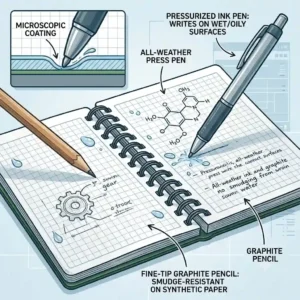
Practical Usage Guide: Maximizing Synthetic Paper
Buying waterproof notebooks is only half the equation; adapting your workflow to their unique chemistry is where the real transformation happens. Traditional paper absorbs ink via capillary action, pulling the liquid down into the wood fibers. Synthetic and coated papers reject this absorption, meaning the ink must dry entirely on the surface through evaporation or utilize a binder that adheres to the plastic/stone matrix.
The 30-Day Transition Protocol:
When you first switch to all-weather stationery, you will likely make the common mistake of using your favorite gel pen (like a Pilot G2). The result will be a smeared, illegible mess.
-
Audit Your Writing Instruments: Immediately remove all water-based rollerballs, gel pens, and fountain pens from your field kit. Replace them with standard pencils (HB or 2B lead works best), Sharpie fine-point permanent markers, or pressurized ballpoint pens (like the Fisher Space Pen or Tombow AirPress).
-
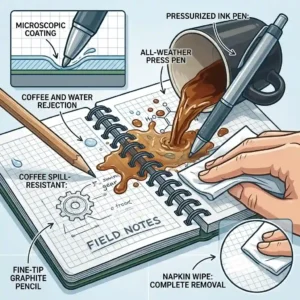
The Wipe-Down Method: If you are working in heavy rain, water will pool on the page. Before writing, run the edge of your hand or a squeegee over the paper to break the surface tension. Pressurized ink will cut through a thin film of water, but it struggles against deep puddles.
-
Archival Storage: If your notebook gets caked in mud, do not scrub it vigorously with a stiff brush, as this can degrade the acrylic coatings (especially on Rite in the Rain products). Instead, rinse it gently under a tap, wipe it with a microfiber cloth, and fan the pages out to air dry overnight. Because the pages won’t stick together as they dry, you don’t need to apply pressure or heat.
Real-World Scenarios: Finding Your Perfect Match
To help you navigate the nuances of these products, let’s look at three specific profiles. Perfect gear fails when placed in the wrong environment, so identifying your use case is paramount.
The Daily Commuter & Student (The Reusable Router)
If your primary enemy is a spilled latte in your backpack or the occasional drizzle while walking across a university campus, you don’t need military-grade survival paper. You need efficiency. For this user, the hybrid reusable smart notebook is the undisputed champion. By wiping the pages clean every week, you drastically reduce backpack weight and completely digitize your notes. Anti-Recommendation: Do not buy heavy stone paper if you are a student; it adds unnecessary weight to an already heavy bag and provides grease resistance you don’t need.
The Heavy Industry Contractor (The Grease Fighter)
If you are operating heavy machinery, working in an auto shop, or managing a culinary kitchen, your primary adversary isn’t just water—it’s oil. Standard synthetic plastics (like Yupo) can become incredibly slick when coated in grease, making them impossible to write on. For this profile, stone paper is mandatory. The calcium carbonate naturally resists lipid bonds, allowing a standard ballpoint pen to cut through motor oil and leave a clean line.
The Forestry & Wildlife Researcher (The Elements Survivor)
When you are mapping out trails in the Pacific Northwest for a week, you are fighting continuous, pervasive dampness, mud, and physical abrasion. You need a notebook that can survive being dropped in a river, stepped on by a boot, and shoved roughly into a damp pocket. Acrylic-coated wood pulp is your best bet here because it retains the rigidity and tactile familiarity of real paper, allowing you to sketch biological specimens with a standard pencil without the lead skipping on a glossy surface.
Problem to Solution: Overcoming Smudging and Bleed
Even the best waterproof gear comes with a learning curve. Over my years in the field, I’ve watched countless junior technicians struggle with problems that are easily solved with a bit of insight.
-
Problem: Ink Smearing Hours Later
-
Solution: You are likely using an oil-based pen that lays down too much volume (like a broad-tip ballpoint). Because the paper isn’t absorbing the oil, it sits on top. Switch to a fine-point (0.5mm) pressurized pen. The smaller ball bearing distributes less ink, allowing the ambient air to dry the binding agents much faster.
-
-
Problem: Ghosting (Seeing words on the opposite side of the page)
-
Solution: This happens frequently with ultra-thin extruded plastics (like the Expedition edition). To combat this, place a thin sheet of matte dark plastic (a “pencil board” or shitajiki) behind the page you are currently writing on. This absorbs the pressure of your pen, preventing the physical embossing of the sheets below it, which often looks like ghosting.
-
-
Problem: Pages Sticking Together After Submersion
-
Solution: While the paper itself won’t degrade, dissolved minerals from muddy water can dry between the sheets and act like a weak glue. If your notebook takes a swim in a dirty river, aggressively rinse the entire notebook in clean tap water before fanning it out to dry.
-
How to Choose Waterproof Notebooks
Selecting the right notebook goes far beyond simply looking for a “water-resistant” badge on the cover. You need to analyze the specific engineering of the product to ensure it matches your workflow.
-
Identify the Core Material Matrix: Ask yourself if you need coated pulp, extruded plastic, or stone composite. Coated pulp (acrylic) tears naturally and feels like regular paper. Extruded plastics (Yupo, Polypropylene) are virtually un-tearable and incredibly thin. Stone composites offer temperature stability and a buttery writing feel but are heavier.
-
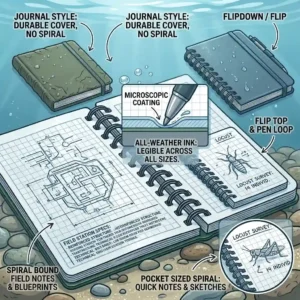
Evaluate the Binding Mechanism: A notebook is only as strong as its binding. Saddle-stitched (stapled) bindings are fantastic for slipping into a pocket, but they don’t lay perfectly flat. Top-bound spirals are the industry standard for field work because they keep the wire out of the way of your hand, regardless of whether you are left or right-handed.
-
Assess the Ruling and Layout: Many survival notebooks cater to specific professions. Look for universal grid layouts, dot-grid (excellent for scaling diagrams), or specific environmental layouts that include rulers, conversion charts, and scale bars printed directly on the inside covers.
-
Check for Archival Quality: If you are taking legal notes or data for federal grants (like USGS surveys), your paper must be acid-free and archival grade. Most high-end synthetic papers naturally meet this requirement, but it is worth verifying to ensure your data survives decades in a filing cabinet.
Common Mistakes When Buying Weatherproof Gear
The spec sheet is a marketing tool; it rarely tells you the whole story about what it’s like to live with a product. Here are the pitfalls I see buyers fall into constantly.
Believing “Water-Resistant” is Waterproof
Many luxury notebook brands claim water resistance. This usually just means the cover has a polyurethane coating, but the internal pages are standard cellulose. If you drop a water-resistant notebook in a puddle, capillary action will draw the water through the edges of the pages, ruining the entire book. True waterproof notebooks have treated or synthetic core pages, not just a tough cover.
Ignoring the “Micro-Climate” of the Notebook
When you close a wet notebook, you trap moisture inside. If the paper is completely synthetic (plastic), the water has nowhere to go. If you open it a week later, it will still be wet. Users often mistakenly believe their notebook is “leaking” when, in reality, they just trapped condensation inside. You must let these notebooks air dry open if you want a dry writing surface later.
Focusing Only on the Paper, Not the Pen
I cannot stress this enough: spending $20 on an indestructible notebook and pairing it with a $1 gel pen is a waste of money. You must factor the cost of a pressurized pen or high-quality mechanical pencil into your initial purchase. Without the right ink chemistry, the paper is useless.
Synthetic vs. Stone Paper: What the Specs Don’t Tell You
The battle between synthetic plastics and stone paper is the most debated topic in modern stationery.
Synthetic Paper (Polypropylene/Yupo):
Engineered from petroleum byproducts, these sheets are stretched and extruded to be incredibly thin. The main advantage here is tensile strength. You can staple through it, pull it, and stretch it, and it will snap back. However, because it is plastic, it possesses a memory. If you accidentally crease a page hard, that crease is permanent. Furthermore, in environments over 180°F (like leaving it on a dark dashboard in Arizona), the plastic can warp and distort.
Stone Paper (Calcium Carbonate + HDPE binder):
Stone paper is essentially rock dust held together with a tiny amount of plastic. It feels dense, heavy, and incredibly smooth. What the specs won’t tell you is how it ages. Because it is mostly mineral, it is highly susceptible to prolonged UV degradation. If you leave a stone paper notebook in direct sunlight for months, it will begin to photodegrade and crack (an intentional eco-friendly feature). Furthermore, if you pull hard on stone paper, it doesn’t snap back; it stretches and deforms permanently, much like taffy. Choose stone for cold weather and grease; choose synthetic for high abrasion and wet pockets.
What to Expect: Real-World Performance Under Duress
When testing these products, I look for the “failure point”—the exact moment the engineering gives out.
If you submerge an acrylic-coated wood pulp notebook for 48 hours, the edges will begin to fray. The coating protects the flat surface, but the micro-cuts at the edges expose the wood fibers to water. It will survive, but it will look heavily weathered and swell slightly.
If you expose a reusable smart notebook to a dusty, sandy environment (like a desert survey), the fine silica sand will stick to the microfiber cloth used to wipe it. When you attempt to erase the pages, you will inadvertently sand-blast the polyester coating, leaving permanent micro-scratches that ruin the optical clarity for the scanner app.
Understanding these physical limitations is vital. There is no perfect, invincible notebook. There are only materials optimized for specific hazards. By matching the chemical composition of the paper to the primary hazard of your environment, you eliminate the friction of data loss.
Conclusion
Navigating the landscape of waterproof notebooks in 2026 reveals an impressive array of material engineering, shifting far beyond the stiff, waxy field journals of the past. Whether you are leaning towards the authentic grit of an acrylic-coated field pad, the high-tech sustainability of a reusable digital hybrid, or the rugged cold-weather dominance of stone paper, the key is aligning the product’s chemistry with your specific environmental hazards.
Investing in the right all-weather stationery acts as a cheap insurance policy for your most valuable asset: your data and your time. Stop relying on fragile cellulose and delicate gel pens when the elements turn against you. Equip yourself with the right materials, adapt your writing tools, and you will never lose a critical measurement, brilliant idea, or vital field note to a sudden downpour again.
FAQs
❓ What kind of pen works best on waterproof notebooks?
✅ Standard graphite pencils and pressurized ballpoint pens (like the Fisher Space Pen) perform the best. Avoid gel pens, fountain pens, and water-based markers, as their ink will bead up, smear indefinitely, and fail to adhere to the synthetic coatings…
❓ Are waterproof notebooks environmentally friendly?
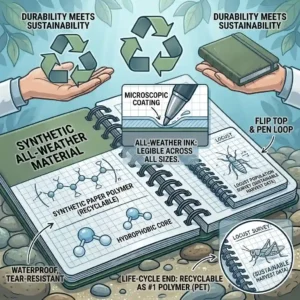
✅ It depends on the material. Stone paper uses no water or wood pulp and photodegrades over time. Some synthetics are highly recyclable (like HDPE blends). However, acrylic-coated wood fibers can be difficult to recycle in standard municipal paper streams…
❓ Can I write in a waterproof notebook while it is completely submerged?
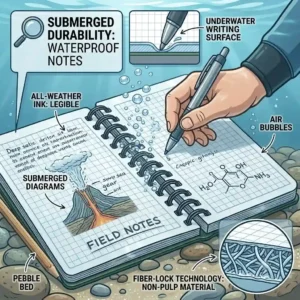
✅ Yes, but only with specific tools. A standard pencil or a specialized pressurized pen will write underwater on both synthetic and acrylic-coated paper. Standard ballpoints rely on gravity and will stop working once water enters the pen tip…
❓ Do reusable smart notebooks work in the rain?
✅ Most reusable synthetic notebooks repel water perfectly. However, the specialized thermo-sensitive erasable ink they require often runs or fades when exposed to heavy moisture or extreme heat, making them less ideal for true outdoor survival environments…
❓ How do I dry a waterproof notebook if it gets soaked?
✅ Do not use high heat, as it can warp synthetic pages. Simply shake off the excess water, gently wipe the pages with a towel, and fan the notebook open on a desk in a well-ventilated, room-temperature area overnight…
Recommended for You
- 5 Best reusable notebooks of 2026: An Expert’s Unfiltered Buying Guide
- 5 Best Mini Spiral Notebooks for Everyday Carry in 2026 (Expert Tested)
- 5 Best Leather Pocket Notebooks of 2026: An Expert’s Unbiased Guide
Disclaimer: This article contains affiliate links. As an Amazon Associate, I earn from qualifying purchases. If you purchase products through these links, we may earn a small commission at no additional cost to you.
✨ Found this guide helpful? Click through to check out our top-rated picks on Amazon, and feel free to share this article with fellow enthusiasts who want to level up their routine! 💬🤗
[addtoany]
