
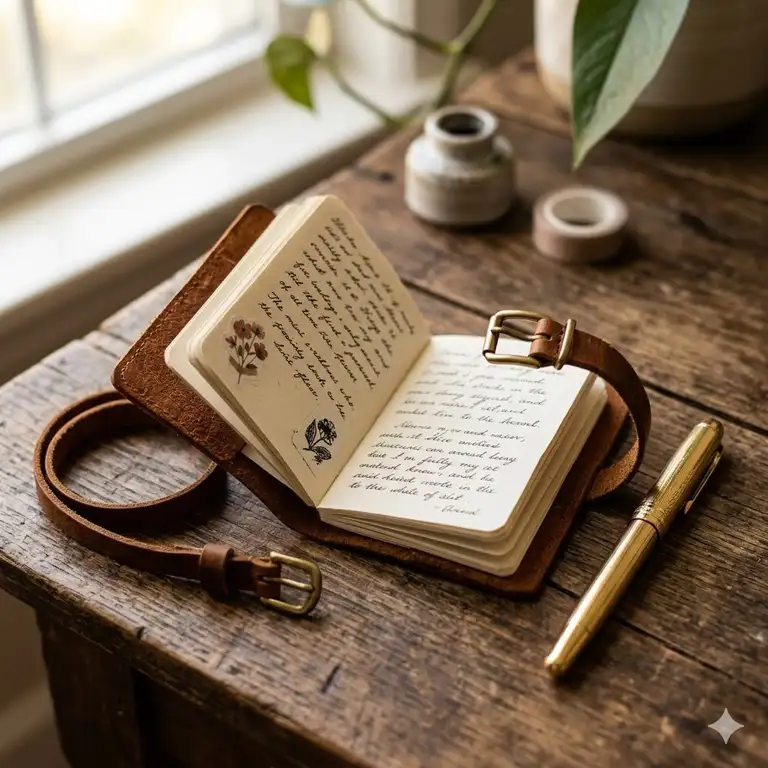
If you have ever lost a brilliant idea because you couldn’t write it down fast enough, you already understand the critical value of a mini journal. In my over ten years of working as a productivity consultant and stationery tester, I’ve filled hundreds of pocket notebooks. What most people don’t realize is that downsizing your writing canvas actually forces a kind of cognitive clarity. When you only have a 3.5 by 5.5-inch page, every word must earn its keep.
But what exactly is a mini journal? Functionally, it is a compact, highly portable notebook designed to fit seamlessly into a front pocket, everyday carry (EDC) pouch, or small handbag, typically sized at A6 (4.1 x 5.8 inches) or smaller. However, from an expert’s perspective, it is a mobile capture tool that bridges the gap between fleeting thoughts and permanent records.
In my field tests, I’ve found that the market is flooded with cheaply bound impostors that fall apart after two weeks in a denim pocket. A true everyday companion needs to survive friction, sweat, and constant opening and closing. This guide isn’t just a regurgitation of manufacturer specifications; it is a battle-tested analysis. We are going to look beyond the marketing hype to examine paper grain, binding integrity, and cover durability. Whether you are a daily commuter braving the subway or a creative professional capturing inspiration on the fly, finding the right tool will transform how you process the world around you.
Quick Comparison: Top Pocket Companions of 2026
To help you make an informed decision quickly, I have synthesized my field data into a comparative matrix.
| Product Model | Dimensions (Inches) | Paper Quality | Binding Type | Best For | Est. Price Range |
| Moleskine Volant Extra Small | 2.5 x 4.1 | 70 gsm, Acid-free | Stitch bound | Extreme minimalism | Under $15 (2-pack) |
| Leuchtturm1917 A6 Pocket | 3.5 x 5.9 | 80 gsm, Acid-free | Smyth-sewn | Structured archiving | $15 – $22 range |
| Field Notes Original Kraft | 3.5 x 5.5 | 60 lb Text | Saddle-stitched | Rugged daily carry | $10 – $15 (3-pack) |
| Paperblanks Micro | 2.75 x 3.5 | 85 gsm, Laid paper | Smyth-sewn | Elegant gifting | $12 – $18 range |
| Rite in the Rain No. 371FX-M | 3.25 x 4.62 | Water-resistant | Stapled | Outdoor/Harsh conditions | Under $10 |
Looking at the comparison above, the Leuchtturm1917 delivers the best value for structured thinkers due to its higher GSM and numbered pages, but if absolute elemental survival is your priority, the Rite in the Rain’s acrylic-coated paper justifies its specialized use case. Budget buyers should note that while Field Notes seem cheaper upfront, their lower page count and saddle-stitched binding mean you will run through them faster, making the Leuchtturm1917 a better long-term investment for heavy writers.
💬 Just one click — help others make better buying decisions too! 😊
[addtoany]

Top 5 Pocket Notebooks: Expert Analysis
1. Moleskine Volant Journal (Extra Small)
The Moleskine Volant Journal (Extra Small) stands out for its virtually weightless profile, making it the undisputed champion of “forget it’s there until you need it” carry. Featuring 56 pages of 70 gsm acid-free paper with a flexible cover, the specifications seem standard, but in the real world, this translates to a book that molds perfectly to the curve of your thigh in a front pocket.
In my experience, the 70 gsm paper is notorious for ghosting (seeing the ink on the reverse side), meaning if you use a wet rollerball or a fountain pen, you are effectively cutting your usable pages in half. However, for those using standard ballpoints or mechanical pencils, this is a non-issue. I highly recommend this for the extreme minimalist or the runner who wants to track miles without carrying bulk. The tear-away pages at the back are a godsend for leaving quick notes for others without destroying the book’s structural integrity.
Customers generally praise its ultra-compact footprint but frequently complain about the thin paper quality when using gel pens.
Pros:
-
Incredibly lightweight and pliable
-
Perforated back pages for easy sharing
-
Comes in a cost-effective two-pack
Cons:
-
70 gsm paper bleeds with wet inks
-
Spine tape can peel after heavy pocket friction
Verdict: Sitting in the under $15 range for a two-pack, it’s a high-value disposable option for pencil and ballpoint users.
2. Leuchtturm1917 Softcover A6 Pocket Notebook
The Leuchtturm1917 Softcover A6 Pocket Notebook elevates the pocket experience with German engineering, boasting 121 numbered pages and a blank table of contents. The 80 gsm paper might only sound marginally thicker than the Moleskine, but Leuchtturm utilizes a specific surface sizing that makes it vastly superior for fountain pen ink, preventing feathering (where ink spreads like spider webs).
What the spec sheet won’t tell you is how crucial that table of contents becomes after three months. In my field tests, trying to find a specific phone number or project idea in a standard notebook is infuriating. With the Leuchtturm, I index as I go. This is tailored for the meticulous professional, the bullet journalist, or anyone who treats their mini journal as a searchable database rather than a disposable scratchpad.
Most reviewers claim it’s the best pocket notebook available, but in practice, I found the softcover’s overhang (the cover extends slightly past the pages) is prone to dog-earing if shoved hastily into a tight bag.
Pros:
-
Pre-printed index and numbered pages
-
Excellent ink tolerance for 80 gsm
-
Includes archival stickers for long-term storage
Cons:
-
Cover overhang can get bent in pockets
-
Slightly bulkier than true pocket notebooks
Verdict: Priced in the $15 – $22 range, it is the ultimate workhorse for organized thinkers who want a permanent archive.
3. Field Notes Original Kraft Memo Books
The Field Notes Original Kraft Memo Books lean heavily into Americana nostalgia with a robust 60 lb text paper and a simple 3-staple saddle-stitched binding. The 60 lb text weight translates to a highly absorbent, slightly toothy surface that grips graphite beautifully but acts like a sponge with wet inks.
If you are a contractor, a weekend hiker, or a mechanic, this is your tool. What surprised me most during use was how the kraft cover ages. It doesn’t stay pristine; it absorbs oils from your hands, gets scuffed, and develops a beautiful, personalized patina. However, a major hidden issue is the staples. If you sweat heavily or get caught in the rain, those steel staples will rust and bleed onto the centerfold pages. To prevent this, I often rub a tiny amount of beeswax over the external staples before my first use.
Customer feedback highlights the rugged charm and perfect sizing, though left-handed writers often note the spine staples can catch on their palms.
Pros:
-
Excellent, toothy paper for pencils
-
Ages beautifully with a rugged patina
-
Highly flexible for back-pocket carry
Cons:
-
Staples can rust in humid environments
-
High ink absorption leads to feathering
Verdict: Floating in the $10 – $15 range for a three-pack, they offer incredible rotational value for blue-collar professionals and pencil enthusiasts.
4. Paperblanks Micro Journal
The Paperblanks Micro Journal is where aesthetic meets utility, featuring opulent, historically inspired covers and 85 gsm laid paper. Laid paper is manufactured on a wire cylinder, giving it a subtle ribbed texture that you can actually feel under your pen. This texture forces you to slow down your handwriting, which I’ve found incredibly beneficial for mindful journaling or capturing poetry.
The smyth-sewn binding is the real hero here. Unlike glued bindings that snap when forced open, smyth-sewing means the book lies perfectly flat no matter where you open it. I recommend this specific model for those who want their mini journal to feel like a premium artifact—it makes a phenomenal gift. However, the rigid, ornate covers mean it does not conform to a pocket; it is strictly a bag, purse, or jacket-pocket carry.
Reviewers are obsessed with the visual appeal, though some note the magnetic clasps (on certain models) can wear out after a year of heavy use.
Pros:
-
Stunning, textured laid paper
-
Smyth-sewn binding lies completely flat
-
Exquisite, historically inspired cover art
Cons:
-
Rigid cover makes tight pocket carry uncomfortable
-
Clasp mechanisms add unnecessary bulk
Verdict: Hovering in the $12 – $18 range, it is a premium tactile experience best suited for creatives and thoughtful gift-giving.
5. Rite in the Rain All-Weather Mini Pocket Notebook
The Rite in the Rain All-Weather Mini Pocket Notebook (No. 371FX-M) is an engineering marvel designed for the most hostile environments on earth. The paper is treated with a patented water-based acrylic coating that completely repels water, sweat, mud, and grease.
The practical interpretation of this coating is crucial: water-based pens (like fountain pens or standard rollerballs) simply will not work on this paper; the ink will bead up and smear indefinitely. You must use a standard ballpoint pen, a specialized space pen, or a pencil. In my years testing gear, I’ve left one of these in a pair of jeans through a full washing machine cycle, and while the cover warped, the notes written in pencil were 100% legible. This is the only logical choice for first responders, farmers, or anyone working in maritime conditions.
Customers revere its indestructible nature but frequently warn new buyers about the strict pen compatibility requirements.
Pros:
-
Completely waterproof and grease-proof
-
Survives the washing machine
-
Highly durable top-bound wire-o option available
Cons:
-
Incompatible with gel and fountain pens
-
Paper feels slightly waxy to the touch
Verdict: Usually found for under $10, it is an essential piece of survival gear disguised as stationery.
✨ Don’t Miss These Exclusive Deals!
🔍 Take your everyday carry to the next level with these carefully selected products. Click on any highlighted item to check current pricing and availability. These tools will help you create authentic analog systems your future self will thank you for!
Practical Usage Guide: Setting Up Your Pocket System
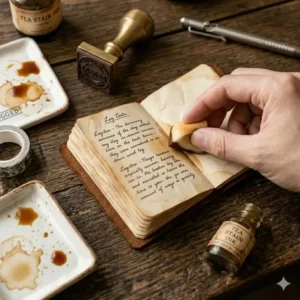
Merely buying a mini journal will not make you organized; the magic lies in how you prime the canvas. In my decade of testing workflow systems, I’ve developed a “Year One” roadmap for pocket notebooks that prevents them from becoming chaotic scribbles.
Step 1: Breaking the Spine Safely
Never take a brand-new, glued or smyth-sewn notebook and rip it open to the middle. This breaks the glue and guarantees pages will fall out by month two. Instead, stand the book on its spine. Let the front cover fall, then the back cover. Then open ten pages from the front, press down gently along the seam, and alternate with ten pages from the back. Work your way to the middle. This trains the binding to open flat without snapping the structural integrity.
Step 2: The Two-Page Index Hack
Even if your notebook lacks a pre-printed index (like the Field Notes), you must create one. Reserve the first two pages. Number your pages manually as you go (just odd numbers to save time). When you write down a crucial piece of data—like a paint color code or a Wi-Fi password—log it in the front index immediately.
Step 3: The End-of-Life Migration
A mini journal is meant to be a temporary capture device, not a permanent home for major projects. Once a week, implement a “migration ritual.” Review the week’s scribbles. Cross out completed tasks, and migrate critical long-term information to a larger desk notebook or a digital tool like Evernote or Notion. This ensures your pocket carry remains a high-speed tool, not a clogged filing cabinet.
The Bleed-Through Dilemma: A Problem-Solving Guide
One of the most persistent pain points buyers face is ink bleed-through, ghosting, and feathering. When you have less than 100 pages, losing half of them because you can only write on one side of the sheet is a massive hidden cost. Here is how to conquer the paper dynamics.
The Problem: Capillary Action
When a liquid ink (from a gel or fountain pen) hits low-GSM paper, the paper fibers act like tiny straws, pulling the ink outward (feathering) and downward (bleeding). This is especially common with the Moleskine Volant and Field Notes.
Solution 1: Switch to Micro-Point Pens
If you refuse to change notebooks, change your weapon. Drop your 0.7mm gel pen and switch to a 0.38mm or 0.28mm ballpoint or ultra-fine gel. By reducing the sheer volume of ink hitting the paper, the thin pages can absorb the fluid without passing it through to the other side.
Solution 2: The “Right-Side Only” Method
If you are stubbornly committed to wet inks, adopt the “Right-Side Only” indexing method. Write your core entries solely on the right-hand (recto) pages. Use the back of the previous page (the left-hand, verso page) exclusively for drawing connecting arrows, making short annotations, or pasting receipts. This turns ghosting into a non-issue while maximizing the book’s utility.
Solution 3: Upgrade to Sized Paper
If neither compromise works, you must buy notebooks specifically treated for wet inks. Look for terms like “surface sizing” or paper weights above 80 gsm. The Leuchtturm1917 mentioned earlier is the perfect upgrade path for this specific dilemma.
How to Choose the Right Mini Journal
Selecting the correct pocket notebook requires moving past the cover art and looking at three specific criteria.
1. Assess Your Typical Carry Environment
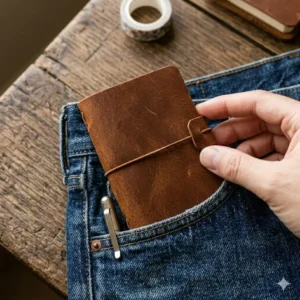
Your environment dictates the required cover rigidity. If you carry your notebook in a loose jacket pocket or a bag, a rigid hardcover or a thick Paperblanks model is ideal; it provides a built-in lap desk for writing in the air. However, if you carry it in your back jeans pocket, a hardcover will snap, or worse, cause spinal misalignment when you sit. Back-pocket carriers must choose flexible softcovers like Moleskine or saddle-stitched memo books.
2. Match the Paper to the Pen (GSM vs Sizing)
Many buyers assume a higher GSM (Grams per Square Meter) automatically means better paper. This is a myth. GSM only measures weight, not ink resistance. A 60 gsm paper with heavy gelatin “sizing” (a surface treatment that fills the microscopic gaps between paper fibers) will handle a fountain pen better than a 100 gsm paper with no sizing. If you use pencils, you want toothy, unsized paper. If you use ink, look for “ink-proof” or sized paper claims.
3. Evaluate the Binding Type
-
Stapled/Saddle-Stitched: Cheap, flexible, but prone to rust and tearing. Best for 30-day use.
-
Perfect Bound (Glued): Common in cheap notebooks. Pages fall out once the glue dries and cracks. Avoid for long-term use.
-
Smyth-Sewn: Groups of folded pages (signatures) are stitched together, then glued to a spine. This is the gold standard, ensuring the book lies flat and pages never fall out.
Common Mistakes When Buying Pocket Notebooks
In my consulting work, I see professionals make the same purchasing errors repeatedly, prioritizing marketing metrics over practical utility.
Mistake 1: Falling for the “More Pages” Trap
A common instinct is to buy the thickest pocket notebook available to get the best cost-per-page value. However, cramming 200+ pages into a 3.5 x 5.5-inch footprint creates a terrible writing angle. When you reach the bottom corners of a thick, small book, your hand falls off the edge, making writing cramped and illegible. The sweet spot for a mini journal is between 48 and 120 pages.
Mistake 2: Ignoring Cover Overhang
Look closely at the edges of the notebook. Does the cover extend past the paper edges (known as overhang or “squares”), or is it flush-cut? Flush-cut books (like Field Notes) slide in and out of tight pockets smoothly. Books with overhangs catch on pocket seams, leading to bent covers, separated lamination, and structural failure within weeks.
Mistake 3: Buying Without a System in Mind
Buying a blank book without a plan is a recipe for an empty book. Before purchasing, decide its exact purpose. Is it a ledger? Get grid paper. Is it a sketchbook? Get blank pages. Is it a to-do list? Get dotted or lined. A mismatch between the line ruling and your intent will cause subconscious friction, leading you to abandon the notebook entirely.
The Economics of Analog: Long-Term Cost & Maintenance
When assessing the Total Cost of Ownership (TCO) of a mini journal, you have to look beyond the initial purchase price. The true cost includes replacement frequency and the physical degradation over time.
If you buy a $10 three-pack of saddle-stitched memo books, each book will likely survive about a month of heavy pocket carry before the cover detaches or you fill its 48 pages. Over a year, you are spending roughly $40.
Conversely, a $20 premium smyth-sewn notebook with 192 pages will likely last you 4 to 6 months. In this scenario, the premium option is actually the same price or cheaper annually, while providing a vastly superior writing experience and better archival qualities.
Furthermore, maintenance matters. For leather or faux-leather covers, keeping them away from extreme heat (like leaving them on a car dashboard) prevents the adhesives from melting. For paper covers, applying a simple strip of clear packing tape along the spine on day one can double the lifespan of the book by preventing friction wear. According to preservation guidelines from The Library of Congress, keeping paper away from direct sunlight and high humidity prevents the rapid acidification that turns cheap paper yellow and brittle.
Paper Dynamics: Why Your Notebook Feels the Way it Does
To truly appreciate a high-quality notebook, you need to understand the basic chemistry and engineering of paper. The tactile experience you enjoy—or hate—is dictated by the length of the cellulose fibers and the additives mixed into the pulp.
When a manufacturer claims their paper is “acid-free,” it means the paper was produced in an alkaline environment, usually buffered with calcium carbonate. Standard paper contains lignin (a polymer in wood), which breaks down into acids over time, causing the paper to yellow and crumble—think of an old newspaper. If you plan to keep your mini journal for decades to reference your life’s history, acid-free paper (found in the Leuchtturm1917 and Moleskine) is non-negotiable.
Additionally, consider the “tooth” of the paper. Tooth refers to the microscopic hills and valleys on the paper’s surface. High-tooth paper feels rough and is excellent at scraping graphite off a pencil, making your lines dark and rich. Low-tooth, highly calendared paper (run through hot metal rollers during manufacturing) feels like glass. It is terrible for pencils, causing them to smear, but it is absolute perfection for a smooth fountain pen nib, which will glide across the page effortlessly.
✨ Don’t Miss These Exclusive Deals!
🔍 Ready to upgrade your daily carry? Click on any highlighted product above to check current pricing and secure a notebook that actually matches your writing style. Don’t settle for bleeding ink and broken spines!

Conclusion: The Power of the Pocket
In an era dominated by digital notifications and screen fatigue, the mini journal remains one of the most powerful tools for capturing pure, uninterrupted thought. It does not require a battery, it will never distract you with an email, and its physical limitations force you to distill your ideas down to their most essential elements.
As we have explored, not all pocket notebooks are created equal. Buying a cheap, glued spine will lead to lost pages and frustration, while ignoring paper dynamics will turn your wet ink into an illegible mess. Whether you opt for the structured German engineering of the Leuchtturm1917, the extreme elemental survival of the Rite in the Rain, or the rugged charm of Field Notes, the secret is matching the tool to your specific environment and writing instrument. Pick a system, prime your pages, and start capturing the world around you.
FAQs
❓ What is a mini journal used for?
✅ A mini journal is primarily used as an everyday carry (EDC) capture tool to instantly record fleeting thoughts, to-do lists, expenses, or observational sketches. Its compact size ensures it is always accessible, preventing ideas from being forgotten before they can be transferred to a permanent digital or physical system…
❓ What size is a typical mini journal?
✅ The most common sizes are A6 (4.1 x 5.8 inches) or the standard American pocket size of 3.5 x 5.5 inches. Some extreme minimal models measure as small as 2.5 x 4 inches, designed specifically to fit into tight shirt pockets or small clutches…
❓ Can fountain pens be used in a pocket notebook?
✅ Yes, provided you choose the right paper. You must look for notebooks with high-GSM paper (80+) or heavy surface sizing, like Leuchtturm1917. Standard, untreated pocket notebooks will result in severe feathering and bleed-through when exposed to liquid fountain pen ink…
❓ How do I protect my pocket notebook from sweat and rain?
✅ For mild protection, keep the notebook in a leather slipcover or a ziplock bag. For complete protection in harsh environments, purchase a waterproof notebook like Rite in the Rain, which uses acrylic-coated paper that completely repels moisture, sweat, and grease…
❓ Are softcover or hardcover mini journals better?
✅ It depends entirely on your carry method. Softcovers are better for pants pockets as they bend with your body and won’t cause discomfort. Hardcovers are superior for bags or loose jacket pockets, as they provide a rigid, built-in writing surface for taking notes while standing…
Recommended for You
- 5 Best Leather Pocket Journal Options for 2026: Expert EDC Review
- Huge Journal: 7 Best Giant Notebooks for Massive Ideas in 2026
- 7 Best journaling pens for 2026: Elevate Your Daily Writing Now!
Disclaimer: This article contains affiliate links. As an Amazon Associate, I earn from qualifying purchases. If you purchase products through these links, we may earn a small commission at no additional cost to you.
✨ Found this helpful? Share it with your friends! 💬🤗
[addtoany]
